Eat the frog, but choose it the night before
by Andreas Tissen · · updated
It is 08:45. You have coffee, the mail is open, and your list for the day has eleven things on it. One of them matters more than the rest, and you know which. You start with a supplier reply because it is quick, then book the dentist, then tidy a script. At eleven the important one is still untouched.
"Do the hardest thing first" fails at that moment, the moment of choosing. Brian Tracy, who turned the frog into a method, also wrote the fix: choose the evening before.
Tracy's frog
The phrase goes back to a line usually credited to Mark Twain, probably wrongly: if the first thing you do in the morning is eat a live frog, nothing worse will happen to you for the rest of the day. Tracy built a book on it, Eat That Frog! (2001). His frog is your most important task. It is usually the one you are most likely to put off, and his advice is to do it first, before anything else.
The same book has a chapter called "Plan Every Day in Advance", which tells you to write the next day's list the evening before. Put together, the two chapters give you a frog that is already chosen when the morning starts.
Why 08:45 is the wrong time
In the morning every item on the list competes with the frog on equal terms, and the small ones have the advantage: they are short, they are clear, and they end with a tick. Choosing the frog at 08:45 means turning all of them down at once, while the mail is already open.
In the evening nothing has to be started, so you can look at what tomorrow needs without having to begin it, and the choice is made by the person who is planning, and the person at 08:45 only has to read it.
The template behind this post asks for one frog. Two would put a choice back into the morning. It also asks for something that can be finished in a day: "send the proposal to Meridian" fits, while "win the Meridian account" is a project, and the frog is its next day-sized piece.
The day as one task above a line
Pando, the outliner I build, is a tree of bullets that you use in the browser or on the phone, and Claude can read and write in it once you connect it over MCP. A day there can be a bullet with the frog at the top and everything else below a line.
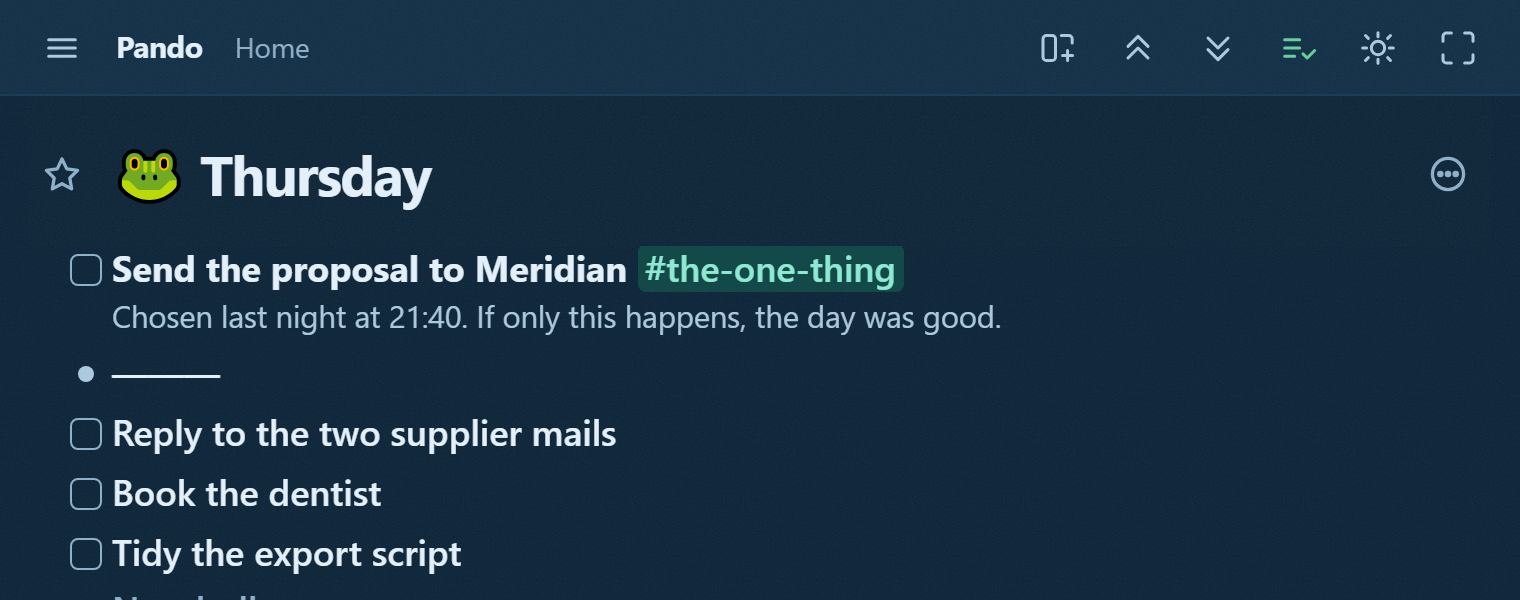
The note on the frog carries the time it was chosen: 21:40. In the morning you can see that the choice was made the night before. The tag appears in the sidebar, and a search for it lists every frog you have chosen, which after a month shows how many got done. The branch is the one-thing template with a Thursday filled in.
When the frogs keep coming from the same corner, the Eisenhower quadrant is where to look for the work that never gets chosen.
Claude brings candidates
With Pando connected to Claude, the evening choice can start from a short list. On your phone, ask Claude for tomorrow's frog. It reads what has been carried over for days, what someone else is waiting on, and which key result has not moved, and proposes two or three candidates with one line of reasoning each.
You pick one of them. Claude writes your choice at the top of tomorrow with the time in the note and puts the other candidates below the line. The template's prompt tells it not to write into the frog's bullet before you have chosen.
Pando is free up to 5,000 bullets, and Pro costs 3 EUR a month. To choose tomorrow's frog tonight with Claude's candidates in front of you, create a free account and connect Claude.