Give your agent a table, not a paragraph
by Andreas Tissen · · updated
Say you are collecting quotes for a new kitchen and ask Claude to keep track of them in your notes: three suppliers, each with an amount, the day you asked and where things stand. Unless told otherwise, it will usually write them down as a paragraph, and on the day it is written the paragraph is fine.
This post is for anyone who lets an agent keep running notes where the same few facts repeat for several items: quotes, orders, applications. I have no measurement showing that a model misreads a short paragraph like that. I am not arguing that it does. The reasons to keep such facts in a table are about the next update and about reading the list yourself.
The paragraph gets rewritten
Facts like these change one at a time. Baltika answers, a quote is confirmed, a supplier declines. With a paragraph, each change means editing prose. The agent rewrites the paragraph or replaces one phrase in it, and the sentence that changes has to be found and reworded around the new fact. After a few weeks the paragraph reads like a history of edits, and if the agent sends back the whole text, anything you typed into it in the meantime goes with the old version.
In a table, the same change is one cell. The agent updates the bullet under State in Baltika's row and touches nothing else.
The gaps are easier to see
The second reason is for you, not the agent. In a paragraph, the supplier nobody chased is a clause in the middle of a sentence. In a table it is an empty cell or an old date in the Asked column. You see it on a phone without reading a word. Here is the kitchen as a table in Pando, the outliner I build, as it looks today in a browser:
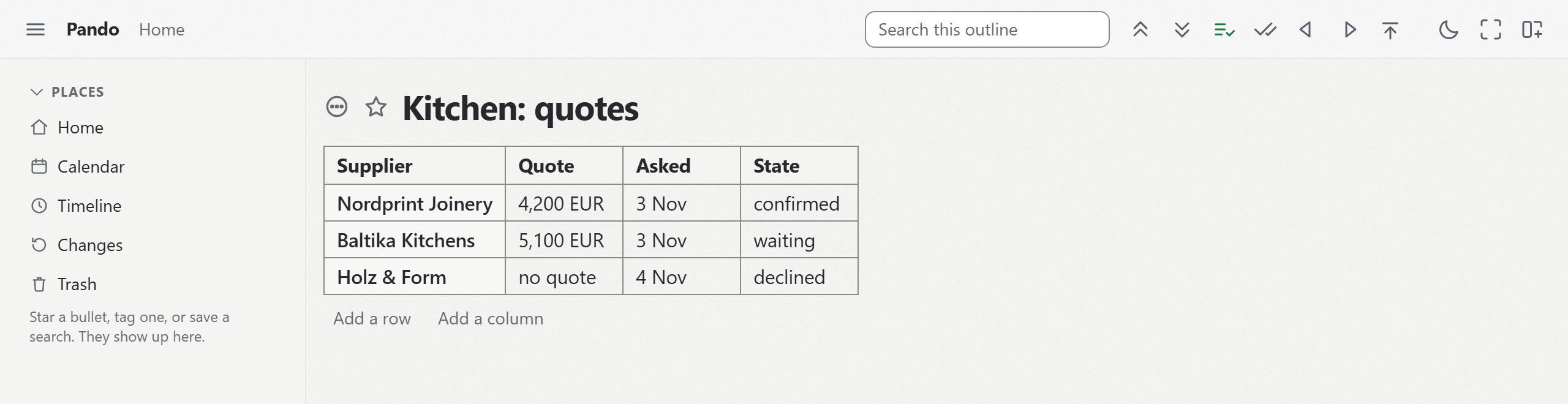
How a table is built in Pando
A table in Pando is a layout on one bullet. Its children are rows, their children are cells, and the first row names the columns. The rows are ordinary bullets, so switching the layout back to a plain list shows the same facts as nested bullets with nothing moved, which means you can start with bullets and make it a table on the day several items turn out to share the same fields.
An agent reads and writes the table over Pando's MCP server with the same tools as any other bullet, and the server's instructions tell it how a table is built. "What did Baltika quote" becomes: find the row, read the cell under Quote. Its remember tool takes a layout too. So a table can also sit inside the agent's own memory bullet, which is part of your outline: you fix a wrong cell on your phone and the agent reads the corrected value next time. Give your agent a memory explains that memory bullet.
The table I use for an agent's errands has the columns Item, Status, Asked and Next, plus a note that briefs the agent, and it is available as a template.
Against a Markdown table or a spreadsheet
You can ask Claude for a Markdown table in a chat or in a note, and for reading it is just as clear. It is still one block of text, so a change to one cell is an edit of that block, and it lives wherever that chat or file lives. A Pando table is made of bullets, so each cell can be written on its own, by the agent or by you on a phone.
If you need formulas, sorting by column or typed columns, use a spreadsheet or a database tool. Pando's tables have none of those. A cell is text. They suit facts that belong in the notes you and the agent already share, such as the state of three quotes, rather than data you want to calculate with. The habit table is another fit, where the empty cells are the useful part.
The rule I give an agent
When a branch has three or more children that share the same fields, ask whether it should be a table, and say which columns you would use. Do not convert without asking.
The second sentence matters to me because the layout of my outline is my choice, and an agent that reshapes it without asking leaves me hunting for my own notes.
The free plan includes tables and agents for up to 5,000 bullets. Connect Claude to Pando and ask it to put the next thing it tracks for you into a table.