The habit table that shows the days you skipped
by Andreas Tissen · · updated
Say your streak was at 41 days when you got the flu. Three days later the app showed 0. The next week you opened it less, because starting again from zero felt worse than not looking.
The streak number keeps one fact: the length of the current run. It says nothing about which days you missed or whether the misses follow a pattern. This post looks at what one study found about missed days, and at a habit table in Pando, the outliner I built, that keeps every blank where you can see it.
What one study found about missed days
In a study published in 2010 in the European Journal of Social Psychology, Phillippa Lally and colleagues at University College London asked 96 volunteers to pick an eating, drinking or activity behaviour and do it daily in the same context, such as after breakfast, for 12 weeks. Each day they rated how automatic it felt. Of the 96, 82 gave enough data to analyse.
For the 39 participants whose curve fitted well, the median time to reach 95 per cent of their own plateau was 66 days. The range ran from 18 to 254 days, and the long end is the model's estimate, since the study itself lasted 84 days. The abstract says that "missing one opportunity to perform the behaviour did not materially affect the habit formation process". It also reports that people who performed the behaviour more consistently fitted the curve better.
So a single missed day is not the event a reset to zero makes it look like. What a count cannot show you is a pattern, such as a habit that goes blank every Saturday. A pattern like that is worth seeing, because it tells you what to change.
A row per habit, a column per day
A table keeps that information: a row per habit, a column per day, an x on the days you did it and nothing on the days you did not. The blanks are as visible as the marks.
A walking row that is full on weekdays and empty at weekends points to a habit that hangs on the commute. A row with a single x after two weeks says the habit has not started yet.
When a row stays blank, two questions help. First, is the habit too big? "Walk 30 minutes" fails on days without 30 free minutes, while "walk after lunch" fails only on days you skip lunch. Second, is it attached to something already fixed in your day? BJ Fogg's Tiny Habits (2019) calls that fixed thing an anchor, as in "after I pour my coffee, I read one page", where pouring the coffee is the anchor and the page is the habit. Both fixes come down to renaming the row, from "Walk 30 minutes" to "Walk after lunch".
What a habit app cannot put side by side
A habit app knows only about habits. The weeks the reading row went empty may be the weeks a client project was due, but the project lives in another app, so nothing puts the two next to each other.
The table in an outline
Any bullet in Pando can be shown as a table: its children are the rows, their children the cells, and the first row names the columns.
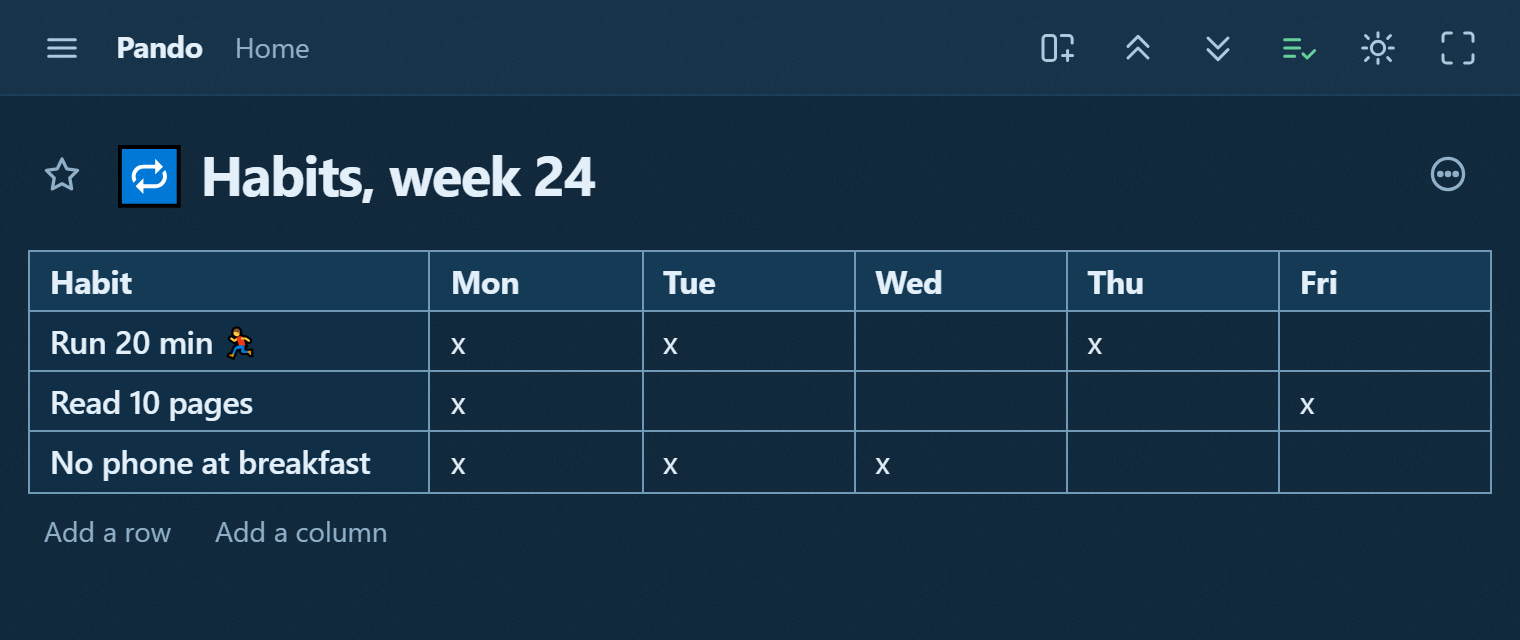
In the picture, week 24, the run happened four days out of seven, reading came back at the weekend, and no phone at breakfast held from Monday to Wednesday and then stopped until Sunday. Each week you duplicate the bullet and clear the cells. Last week then sits one bullet above this one, and comparing the two is a glance.
The habit table template is the same table for a whole week with room for three habits. The link shows it read-only. Its Show in my Pando button copies it to the top of your Home once you have signed in.
Marking the day from your phone
Once Claude is connected to your Pando, you can type "walked after lunch" in the Claude app on your phone. It puts an x in the cell for today. Each cell has exactly one place in the table, so an update is one cell and not a rewritten row, one of the reasons give your agent a table gives for keeping repeating facts in a table.
If your projects and their deadlines are in the same outline, you can ask Claude after a few weeks to read the habit tables next to them. It might point out that the reading row goes blank in the weeks a project was due, which is a reason to give reading a fixed block of time rather than to try harder. What to change stays your decision.
Pando is free up to 5,000 bullets with every feature, agents included, and Pro costs 3 EUR a month. To start a table this week and let Claude fill it in from your phone, create a free account and connect Claude.