Agent reports in layers: bottom line first, the evidence folded underneath
by Andreas Tissen · · updated
An agent has spent an hour on something and reports back in one long reply: what it tried, what it measured, what it changed, what went wrong. The one point you need to decide on is somewhere in the middle. On a phone you skim the first screen and hope the rest says nothing important.
This post is for people who hand real work to Claude or another agent and then have to check it. It describes a report format: one line per finding, with its number, and the evidence nested under each line, so you read the top five lines and open only the one you doubt. Any outliner or a Markdown file with nested lists can hold it. I use it in Pando, the outliner I build, and the example below is from there.
Why a chat reply is the wrong place
In a chat you can get part of the way. Ask for a five-line summary first and details on request, and the agent will do it. The trouble starts the next day. The evidence lived in that session's context, and a new chat starts without it, so "show me the numbers behind the third point" has nothing to answer from. Old replies also cannot be ticked off or answered one finding at a time.
The military calls the first half of the fix BLUF, bottom line up front: the conclusion and the action come first, support after. That fixes the order. The report still needs to keep its evidence somewhere you can open later, one finding at a time.
Five findings as one paragraph
Here are the five findings of a real session report from 15 August 2026, when an agent spent the session on the size of Pando's API answers, first written out as one paragraph:
I removed nine fields that said nothing, which makes reads 37% smaller. Recall used to search the whole outline every time; it can now be asked for its own memory only. The answer to one appendNote call went from 1,971 bytes to 373. I shipped a defect, which the suite caught three hours later. The tool manual grew by 10% while I made the answers smaller.
As a paragraph it reads well enough, until you ask where the 37% comes from or what the defect was. The answer is not in the paragraph, and in a new chat it is nowhere.
The same report, folded
The same five findings as bullets, each written by the agent in the first person, so "I" is the agent:
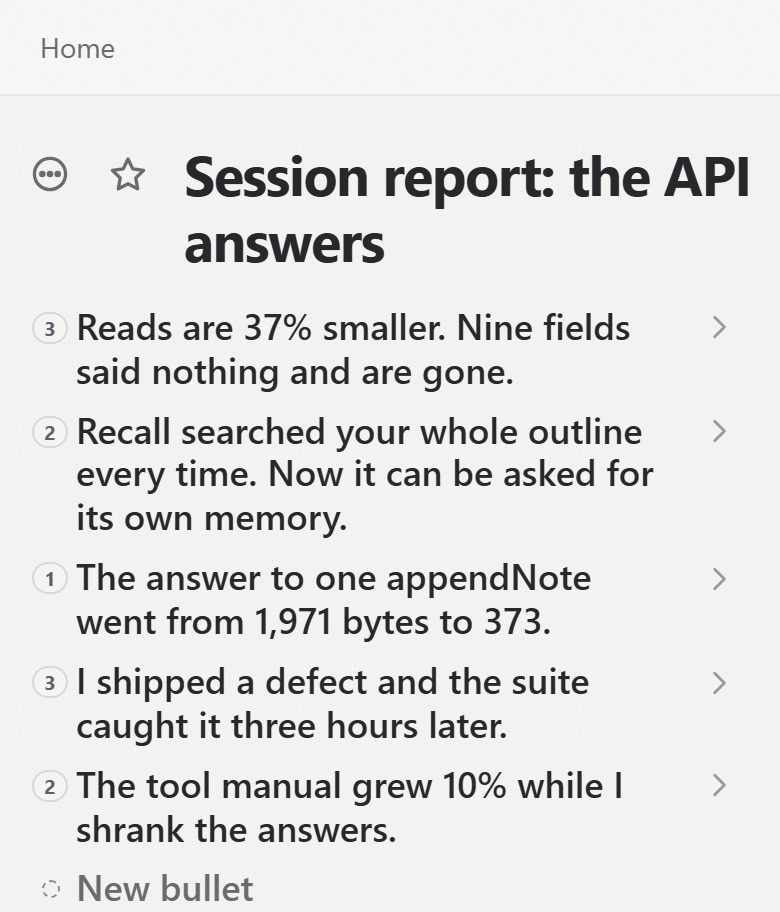
The small circle to the left of each line counts the bullets folded under it. Tapping the first line opens its evidence and leaves the other four closed:
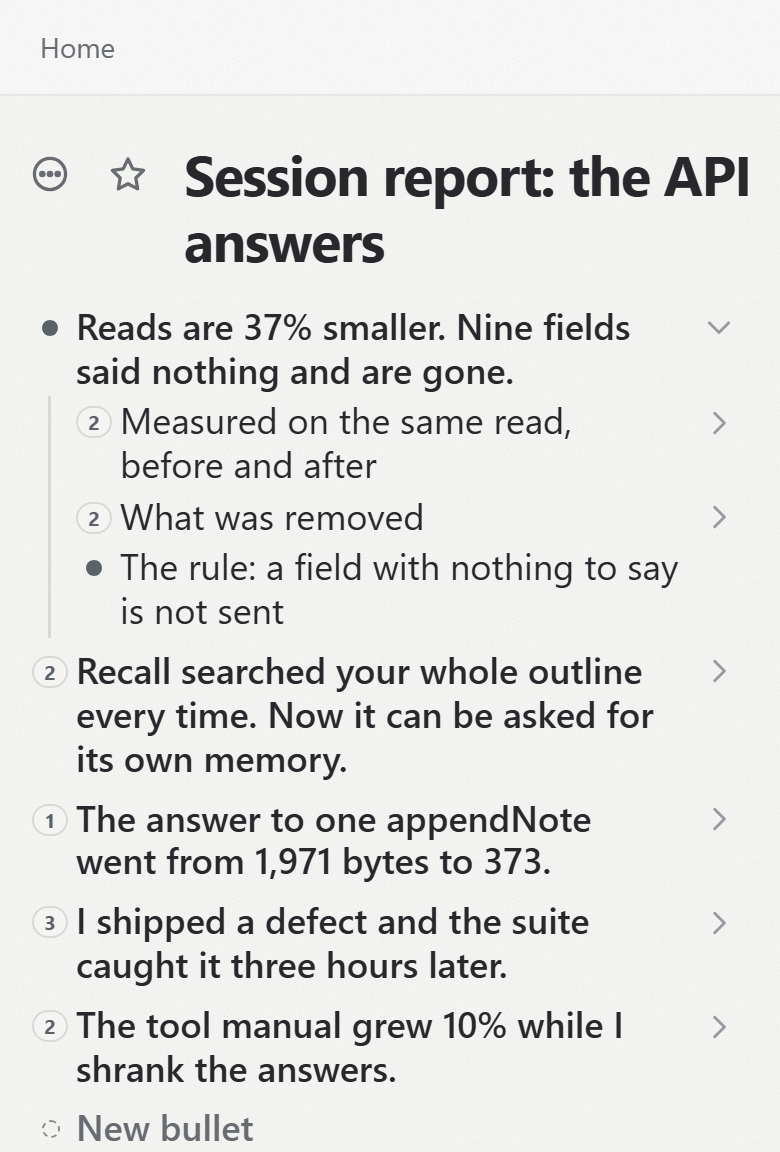
One level further down are the raw figures: 48,427 bytes before and 30,263 after, on one read of 125 bullets at depth 3. Pando's test suite keeps that pair on record. Checking the 37% took three taps, and the other four lines stayed closed.
Four checks for each line
Rule: every line is true and complete on its own, and its children are only evidence for it. Four checks follow from that.
- A parent line states a finding, not a label. "Performance work" is a label; "Reads are 37% smaller" is a finding.
- A child supports its parent and does not repeat it. If the same sentence appears one level down, that level is empty.
- Numbers go to the bottom. The top says 37%; the bottom says 48,427 to 30,263 bytes on 125 bullets.
- Failures sit at the top level too. In the report above, the defect is a top-level line with its own evidence. If failures end up three levels down, you will soon stop trusting the format.
The prompt
I give an agent this instruction once, in its memory, where every new chat finds it (give your agent a memory shows where that lives):
Report in layers, not in prose. Write each finding as one bullet under today's report in the shared branch. Every bullet must be true and complete on its own line and carry its number: "Reads are 37% smaller", not "Performance improvements". Put the evidence in its children, and the raw measurements one level below that. A child must never repeat its parent. Report what failed at the same level as what worked. I read the top layer and open what I care about.
For anything that needs your decision, add: "If a finding needs a decision from me, also write it as a checkbox task in my inbox branch." The decision then sits in a list you tick, described in the inbox your agent writes for you.
Where the report lives
For an agent to write the report into an outline, it needs write access to one. Pando has a hosted MCP server, so a connected agent writes the whole report, bullets and levels, with one create call into a branch you read on your phone or at your desk. Tomorrow's report goes next to today's, and the evidence stays under each finding. Pando runs no model of its own and does not write the report; the assistant you already use does. There is no template for this format, because its shape depends on the day's work.
Trying it costs nothing up to 5,000 bullets. Connect Claude to Pando, put the prompt above into its first chat, and read its next report from the top line down.