The twelve-week year for one person
by Andreas Tissen · · updated
Say you wrote "launch the side project this year" in January. By October the line reads "write the spec". You cannot name the day you decided to make it smaller, because each change felt reasonable at the time and there were always months left.
The twelve-week year is a planning method built against that drift. Below I explain how it works, where it tends to come apart, and how it fits into Pando, the outliner I built, where one branch holds the plan and Claude can do the Friday count.
Twelve weeks instead of twelve months
The method comes from Brian Moran and Michael Lennington's book The 12 Week Year (Wiley, 2013). Their Field Guide (Wiley, 2018) states the argument in its overview: planning by quarter inside a twelve-month year fosters "the false belief that there is plenty of time to get things done", while in a twelve-week year "the illusion of lots of time evaporates". So you treat twelve weeks as the whole year, and the end of the plan comes round four times a year instead of once.
You write a plan for twelve weeks. It is then broken into what you will do each week, with each action small enough that by Friday it is plainly either done or not done, because the score depends on that. Every Friday you score the week: the planned actions you did, as a share of all of them. The book calls it the execution score, and its target is to "successfully complete 85 percent of the activities in your weekly plan". After week twelve it leaves a thirteenth week to look back and set up the next round.
Six planned items with five done is 83 per cent. The book itself says a weekly score under 85 "isn't necessarily bad" if it is better than your last twelve weeks. If you land under 85 three weeks running, try a list that is a third shorter on the next Monday before you try harder, because the plan may have been bigger than the hours you had.
When the plan and the work drift apart
On paper the plan lives in one document. The work lives in another, a task app or a notebook, and that is the one you open every morning. In week two you still open the plan. By week five the task app is where the day happens, and on Friday you are tired and the plan does not get updated.
The score suffers first, because it needs two numbers from two places: what you planned on Monday and what got done by Friday. Then the things that slipped go missing. "The API docs" was planned in week four, did not happen, and by week seven it has fallen off both lists without anyone deciding to drop it.
Week 6 of 12, as one bullet
In Pando the twelve-week plan is one bullet. Its title carries the week number, so "Week 6 of 12" is the first thing you read when you open it.
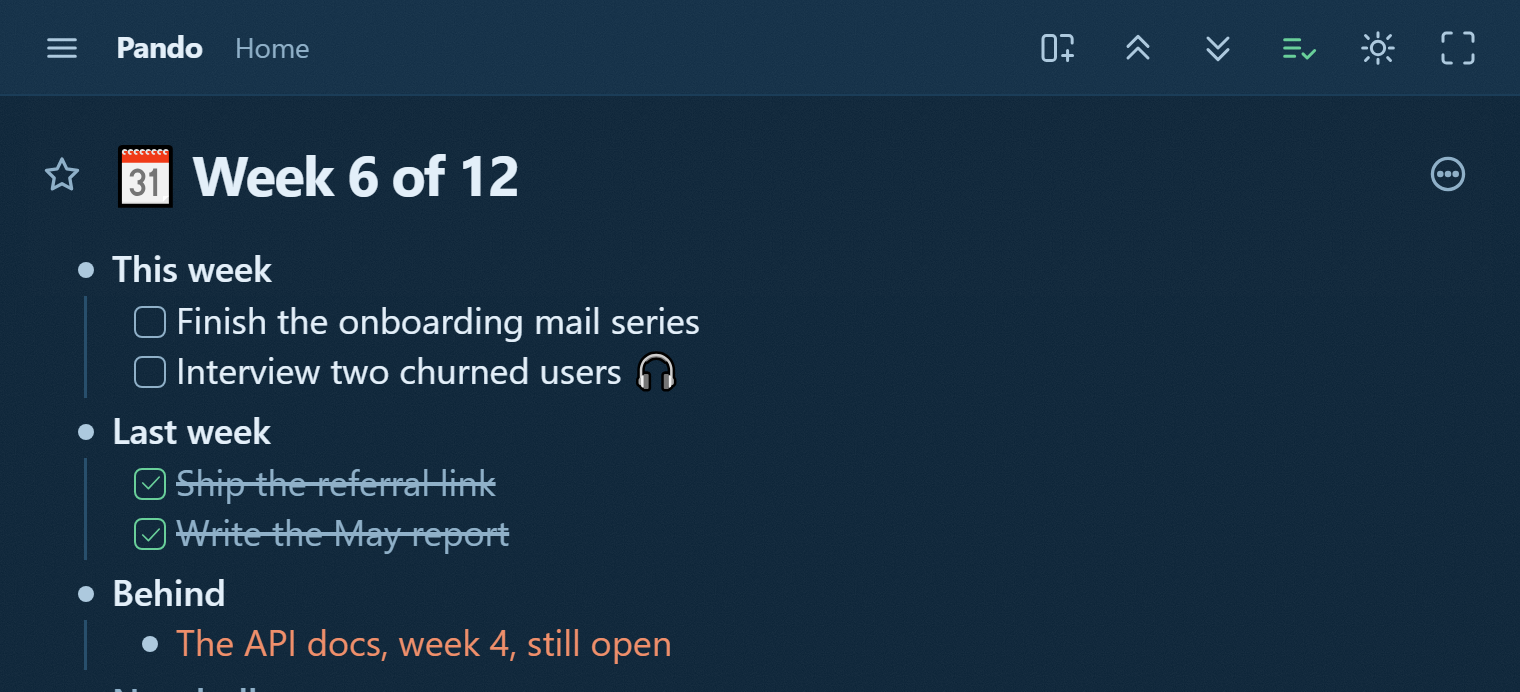
The picture shows three lists, a Score line and a bullet for Claude. This week holds the two or three things you can finish by Friday, as checkboxes, and Last week holds what you ticked, moved down on Monday so that the new week starts with an empty list. Behind holds whatever slipped, with the week it slipped in, so "The API docs (slipped week 4)" stays in front of you until you do it or cross it out on purpose.
The items under This week are ordinary bullets. They can be the real tasks of your projects, mirrored into the week: one bullet standing in two places, ticked once. If you also keep OKRs for the quarter, the same task can sit under the key result it serves. When the twelve weeks end, the post-mortem for the round goes into the same branch as the weeks it looks back on.
The branch is also published as a twelve-week template. The link opens a read-only view. Its Show in my Pando button copies the branch to the top of your own Home once you are signed in. The Score line under the three lists shows 3 planned and 2 done for this week. Its note keeps last week's score.
Letting Claude keep the score
Pando can be added to Claude as a custom connector (in Claude's settings under Customize, then Connectors), and from then on Claude can read this branch and write in it, also from the Claude app on your phone. On Friday you type "score my week". Claude counts the boxes under This week, fills in the Score line, moves what you ticked down to Last week and puts what is still open under Behind with the number of the week it slipped in. The For your agent bullet holds the instruction, "count planned and done, move what is open to Behind", so Claude knows the shape.
Claude only edits when you ask it to. The Changes view in the sidebar lists every edit it made, and because what it writes is ordinary bullets, you can correct any of it by hand on the desk or on the phone.
Pando is free up to 5,000 bullets with every feature, agents included, and Pro costs 3 EUR a month. To run your next twelve weeks with Claude doing the Friday count, create a free account and connect Claude.