The reading notes nobody reads, and how to save them
by Andreas Tissen · · updated
Your highlights are a graveyard. Everyone's are. You read a good book, you mark thirty passages, you export them somewhere with a satisfying import count, and you never open them again. The system worked perfectly. You got nothing out of it.
Laziness is not the reason. Neither is the wrong app. The reason is that a highlight is somebody else's sentence, and you cannot use somebody else's sentence until you have said the thing in your own words. So thirty quotes are thirty pieces of unfinished thinking, and unfinished thinking is work you keep putting off.
One rule: the idea is the parent
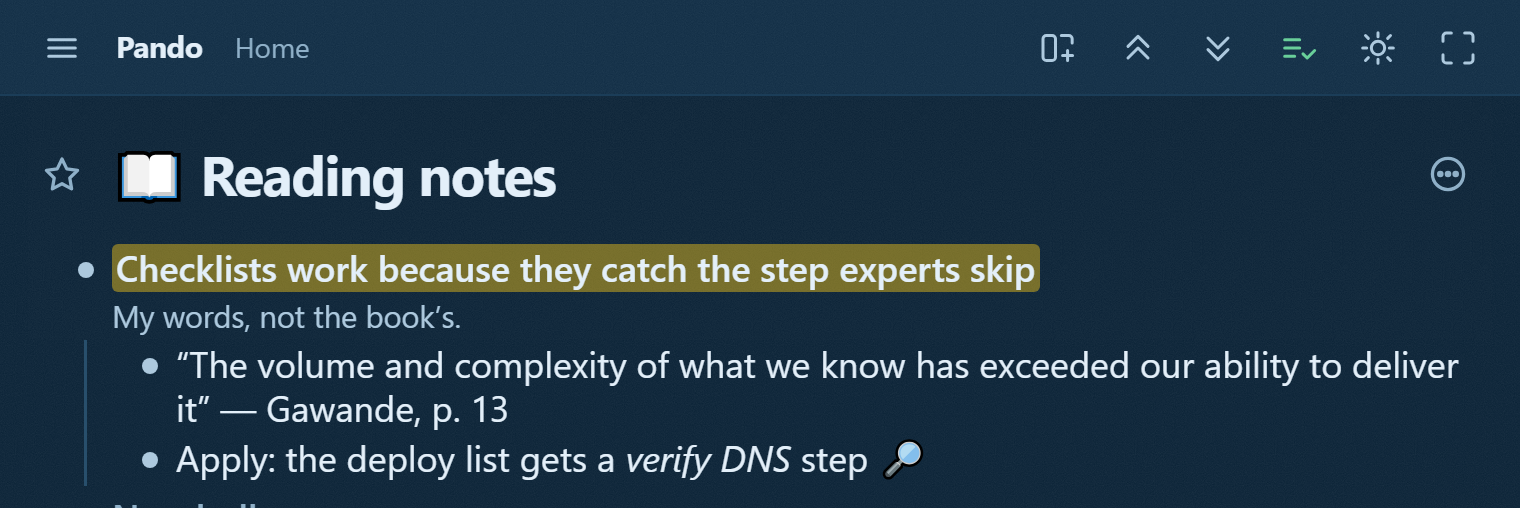
Write the idea, in your words, as the bullet. Put the quote underneath it, as a child, with the page number. That is the whole method.
The inversion costs about fifteen seconds per idea, and it changes what the note is for: the quote stops being the note and becomes the evidence for it, and because your sentence sits at the top, the list turns readable, five ideas you can scan instead of thirty passages you have to re-derive.
The second child matters most: where this applies to you. "The rollback line is the one skipped under load" is worth more than the quote it came from. It is about your work. Gawande was writing about surgery.
Six is a good haul
If a book yields six ideas you can state yourself, that is an excellent book. Thirty highlights usually means you were marking recognition, the pleasant feeling of agreeing with a well-made sentence, and recognition is cheaper than insight.
The test is simple and slightly brutal. Cover the quote. Say the idea. If you cannot, you have not got it yet, and the note is a bookmark rather than a thought.
Give the idea somewhere to go
A good idea from a book eventually becomes a project, a checklist item or a decision, and in one outline that motion is a drag rather than a transcription. The Gawande line about pause points became a release checklist in the tree it was already in. Nothing was retyped. When reading notes live in a separate app, that jump needs somebody to notice the connection AND to retype it, and the second half is where it dies.
Mirrors help here too. An idea that belongs to two topics can stand under both without a copy, so the note never has to be filed under the "right" subject.
Hand the sorting to the agent
An agent given a batch of exported highlights can do the mechanical part: group them by theme, then draft a candidate idea line for each group in plain language. The rewriting stays with you. A summary you did not write is a summary you do not remember.
Your words on top
Open the template, press "Show in my Pando", and try it on the last book you read. Six ideas, your words on top. If you cannot get to six, that is worth knowing about the book.