The Waiting For list: three fields and a Friday check
by Andreas Tissen · · updated
On Thursday a client asks where the signed contract is. You remember that legal promised a draft, and you think it was before the holiday. You search your mail for ten minutes and find their message, dated 27 May: "end of next week". It is now the middle of June. Nobody has chased it.
The work was not yours, so it was in none of your lists, and you found out from the client. Getting Things Done has a list for exactly this, called Waiting For. It is a short list with three fields.
Who, what, and the dates
David Allen's Waiting For list holds everything you have asked of someone else and are now expecting back. Each line needs:
- who owes it,
- what it is,
- the dates: when you asked, and each time you chased.
Anything more and adding a line starts to feel like a form, because a status, a priority or a category each make an entry a little slower to write, and the list is only worth having if every entry goes in. The dates carry the rest. "Asked 27 May, chased 5 June" is a fact you can put in a polite message, and it shows at a glance that the next chase is due.
The minute after you ask
The list fails at the moment of adding. You agree something at the end of a call or at the bottom of a mail, and the project you are working on is open on the screen. If Waiting For lives in a separate app, you would have to switch, find it and type. Usually the line stays unwritten.
The other weak point is reading it. Once a week, go through the list and chase whatever has been silent for more than a week. Inside the weekly review that takes a couple of minutes, if the list is next to everything else the review reads.
One bullet per thing you are owed
Pando, the outliner I build, keeps notes as bullets inside bullets in the browser and on the phone, and Claude can read and write them over MCP once you connect it. Waiting For is a bullet, each thing you are owed is a checkbox under it, and the dates go in the note.
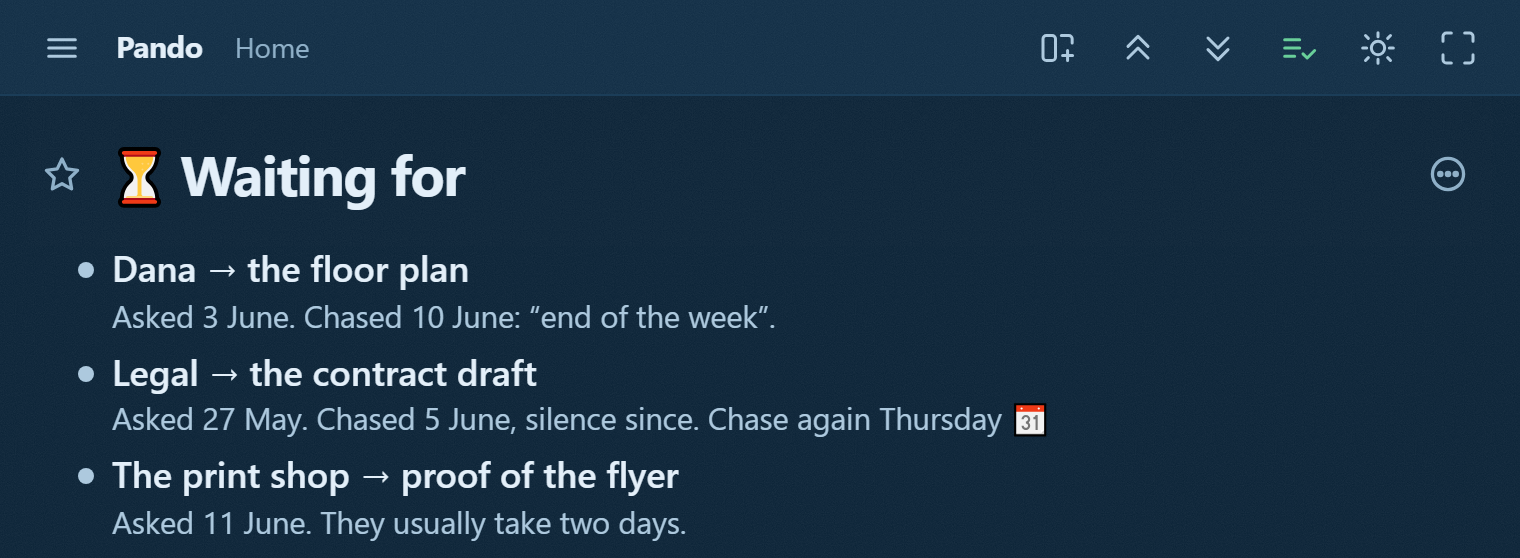
The three lines are examples. A tick means it arrived. The print shop's note says when. Each chase is a small edit to the note ("chased 5 June"), so the history of a line is written down instead of remembered.
You can keep one list or one per project. One per project means you add the line while the project is already open, and when the project ends its open items go with it; a single list is quicker to read on Friday. In Getting Things Done in one outline it is one branch next to Projects. The picture follows the Waiting For template, which comes with three empty lines and one example.
Claude reads the dates on Friday
With Pando connected, the Friday check becomes one request to Claude. Claude reads the Waiting For branch, works out how long each open line has been silent from the dates in its note, and lists the ones past a week, oldest first. Under each it drafts a chase: "Hi, I asked about the contract draft on 27 May and followed up on 5 June. Could you tell me when it will be ready?"
The prompt in the template's agent bullet tells it to send nothing and edit nothing. You adjust the wording for the person, send it yourself and add the date to the note. Adding lines works the other way round, from your phone in the minute after a call: "put legal owes me the contract draft, asked today, under Waiting for".
Pando is free up to 5,000 bullets, and Pro costs 3 EUR a month. To keep a Waiting For list that Claude reads every Friday, create a free account and connect Claude.