The Eisenhower quadrant nobody visits
by Andreas Tissen · · updated
Draw the Eisenhower matrix honestly for your last month and one box will be crowded, two will have a few things in them, and one will be empty. The empty one is important, not urgent. The work in it is the only work that changes anything.
That is the whole finding, and it is uncomfortable because the mechanism is not laziness. You notice urgent things without trying: the phone rings, something breaks, somebody is waiting. Important-not-urgent things make no noise at all. Nobody emails you to say the backup restore has not been tested. So the crowded box fills up daily on its own, and the box your year depends on stays empty unless you put things there on purpose.
The matrix as a board
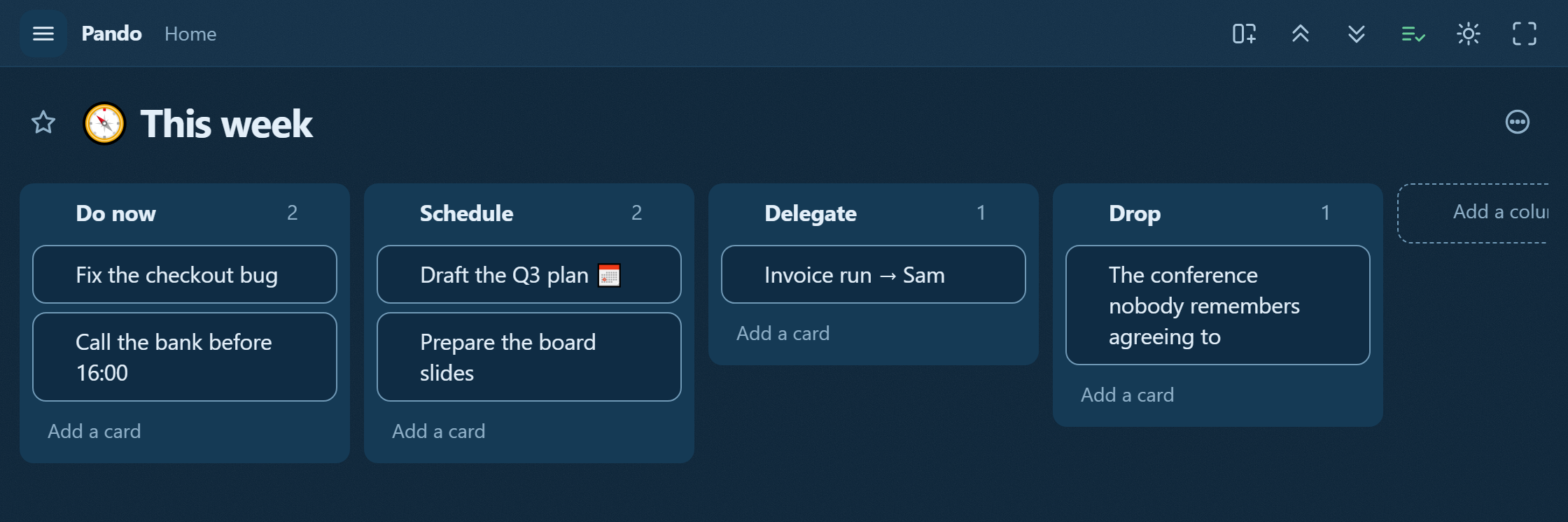
The matrix is a board: four columns, cards you drag between them. Boards scroll sideways, so on a narrow screen you see two or three columns at a time, which turns out to suit the method: you work in one quadrant at a time anyway.
The two useful motions are both drags:
- Right, from Do now to Schedule. An urgent thing that keeps recurring is usually an important thing you never scheduled. The third time production breaks the same way, the card belongs in Schedule as "make it not break", not in Do now again.
- Down and out, to Drop. A card that has sat in "urgent, not important" for three weeks without consequence was never urgent. Delete it, and notice how little happens.
The number to watch
Not how full the board is. How many cards are in Schedule, and whether any of them have a date. An important-not-urgent card with no date is a wish; with a date it is an appointment with yourself, and in an outline a date is not decoration: the card appears on that day beside everything else that carries it.
If Schedule is empty this week, that is the finding, and it is worth more than the rest of the board.
Where the agent is genuinely useful
An agent cannot judge importance for you. What it can do is catch the two lies people tell themselves with this matrix. First, the card that keeps coming back to Do now: the agent can count the repeats and propose the Schedule card that would end them. Second, the cards in Schedule that never get a date. Those stay wishes. That prompt on a Friday, in the same tree as the board, is the difference between a matrix you drew once and one you use.
Take the board
Open the Eisenhower template, press "Show in my Pando", and the four columns stand in your outline with an example card in each. Then move this week's real work into it, and look at what is in Schedule.