Take the decisions out of your meeting notes
by Andreas Tissen · · updated
Be honest about your meeting notes: you have never re-read one. Almost nobody has. The notes exist to make the note-taker feel diligent, and the things that actually mattered are remembered badly by four people who disagree about them a fortnight later.
The fix is not to write better notes. It is to write fewer kinds of line, and to get three of the four kinds out of the meeting note entirely.
Four kinds of line
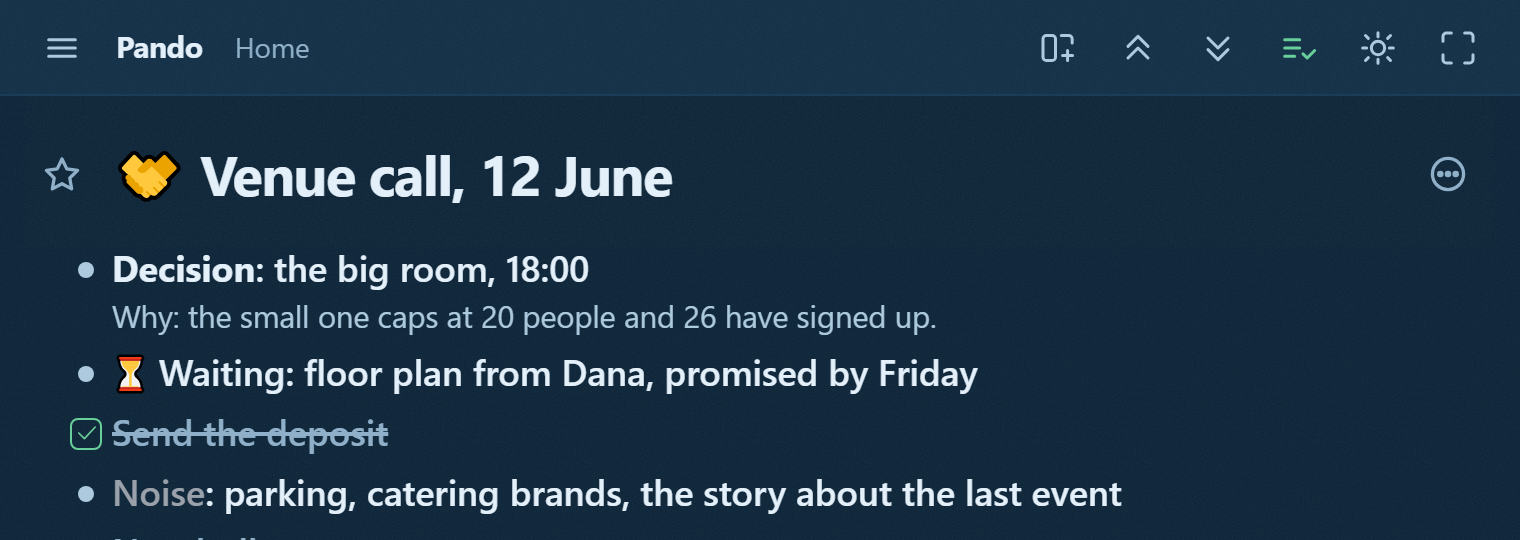
- DECIDED, with the reason. "The island goes against the north wall, because the window seat cannot move." The reason is the half people forget, and without it somebody re-litigates the decision in October.
- WAITING, with who and by when. Somebody promised something. That is not a note; it is a debt.
- NEXT, as a checkbox, with an owner. If nobody owns it, it did not happen in the meeting.
- Noise: everything else. Twenty minutes on tiles with no decision. One line, so the record is honest about how the time went, and then never read again.
Move them, do not copy them
A decision belongs in the project it is about, not in a note about a Wednesday. A waiting-for belongs in Waiting for. A next action belongs under its project.
So after the meeting you drag the three useful lines out to where they live, and what stays behind is the noise line and the date. That is the whole discipline, and in one tree it costs three drags. In separate apps it costs three copy-pastes, which is why in separate apps it does not happen and the notes stay a graveyard.
Because you MOVE the lines rather than copy them, there is exactly one of each. The decision in the project is the decision from the meeting; there is no second version to drift.
What to do while the meeting is running
Type everything as ordinary bullets. Do not sort while people are talking: sorting is a different activity from listening, and doing both badly is worse than doing one well. Prefix as you go if you can, or prefix in the two minutes afterwards while it is fresh.
The test of a good meeting note is not its length. It is whether anybody had to ask, a month later, what was decided.
Where an agent earns its place
The sorting afterwards is mechanical, and an agent reading the note can propose it: which lines look like decisions, which look like debts, which project each belongs under. You approve the moves in a few seconds. The agent must not decide what a decision WAS, because a meeting note is often wrong and only somebody who was in the room knows how.
Take the shape
Open the template, press "Show in my Pando", and use it in your next meeting. Then move the three lines out, and see how little is left.