The post-mortem you will actually write
by Andreas Tissen · · updated
Say you ran a workshop in June. You planned for 20 signups and to break even; 26 people came, it made 340 euros, and at 19:10 the projector died. A week later you are busy with the next thing, and the projector has become a funny story instead of a line on a checklist.
A review at the end might stop the same mistake from happening at the next workshop, if it is short enough to get written. The version below is four lines, and in Pando, the outliner I built, it sits under the project it reviews, where you will see it when you copy that project for the next round.
Four lines
The shape comes from the After Action Review. The US Army devised it after the Vietnam War, as Gregory Sims recounts in "Learning in the Mud", an article published by the CIA's Center for the Study of Intelligence. Its discussion turns on four questions: what you set out to do, what actually happened, what went right or wrong and why, and what you would do differently next time. As four lines, with the workshop as the example:
- Expected: 20 signups, break even. This line is only honest if it comes from a plan written before the work started, such as a five-bullet project brief. If you have to reconstruct it now, note that as your first finding.
- Happened: 26 signups, 340 euros profit, projector died at 19:10. Use the same units as the line above, so the gap needs no explanation.
- Why the difference: one sentence about decisions. "The newsletter mention doubled signups; nobody tested the projector" names something you can repeat and something you can change. "The projector was old" only describes your luck.
- Rule: one rule for next time, as a checkbox, phrased so a stranger could follow it. Here: "The checklist gets test the projector with the real cable".
Write it in the week the project ends. Sims's article gives the same timing for the Army's reviews: soon enough that memories are still fresh.
Why one rule is enough
A rule fits on one line of a checklist. A checklist gets read at the moment the rule applies. Five rules make a document, and on the first day of the next project you would have to remember to open it. Picking the one rule also makes you decide which lesson mattered most.
Reviews filed away from the work
A post-mortem kept in a folder of post-mortems sits apart from the project it describes, and when you plan the next project you are standing in that project, not in the folder, so the rule does not reach the place where it would apply.
The other loss is the pattern across projects. One review tells you about one project. To notice that three of your last five name the same cause in different words, you would have to open five documents and read them side by side.
Under the project, with the rule mirrored forward
In Pando the post-mortem is a bullet under the project, with the four lines as its children.
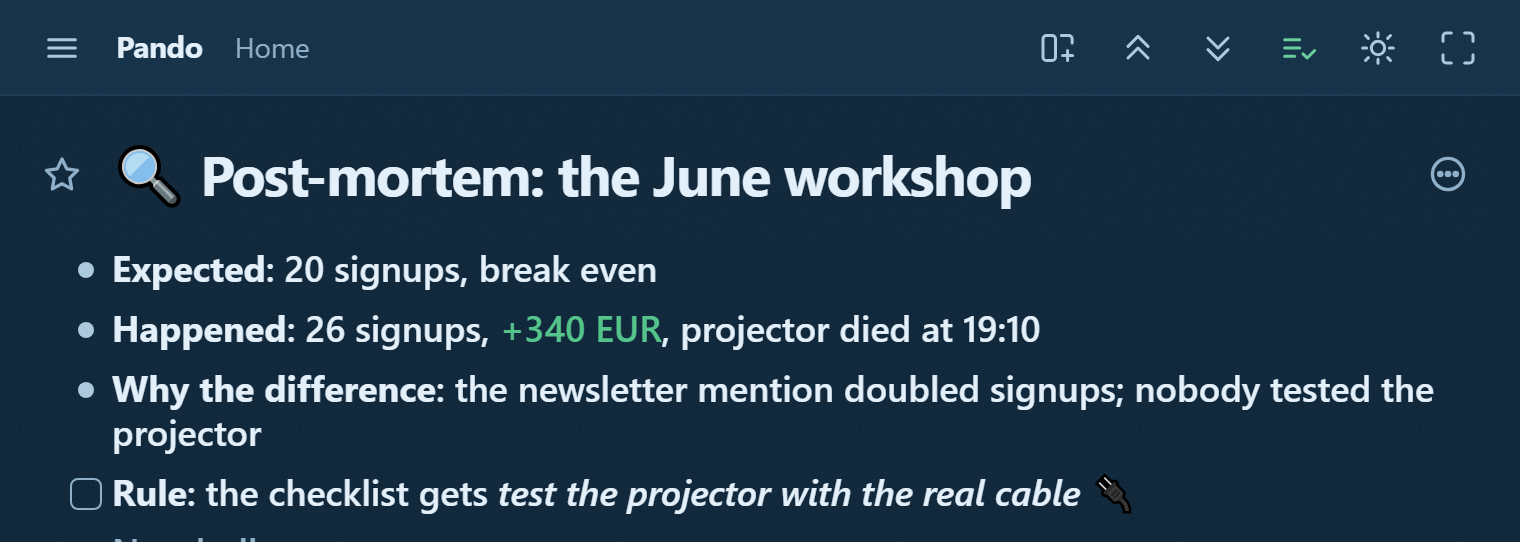
The rule names the checklist it belongs in. Because it is a bullet, you can mirror it into that list, for example the checklist you run before an event, and since a mirror is the same bullet standing in two places, improving the wording once improves it in both.
The post-mortem template has the four lines with a kitchen renovation as its worked example. The link opens a read-only view. Show in my Pando there copies the branch to the top of your Home after you sign in. Filling in the four lines takes a few minutes.
Claude reads the last five
Claude, once you have connected it to Pando, can search your outline for every bullet that starts with "Post-mortem" and read the Why lines side by side, following the instruction that the template's For your agent bullet holds ready to paste. Claude can also draft the Expected line from the brief in the project branch.
What comes back is a candidate pattern, for example "three of your last five say the equipment was not tested". The Why and the Rule stay yours to write, because only you know which decision it was.
Pando is free up to 5,000 bullets with every feature, agents included, and Pro costs 3 EUR a month. To write your first four lines about the last thing you finished, create a free account and connect Claude.