Templates
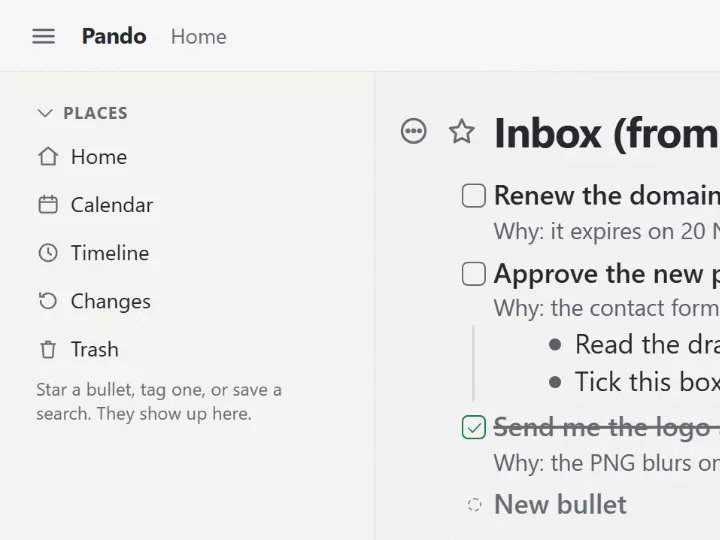
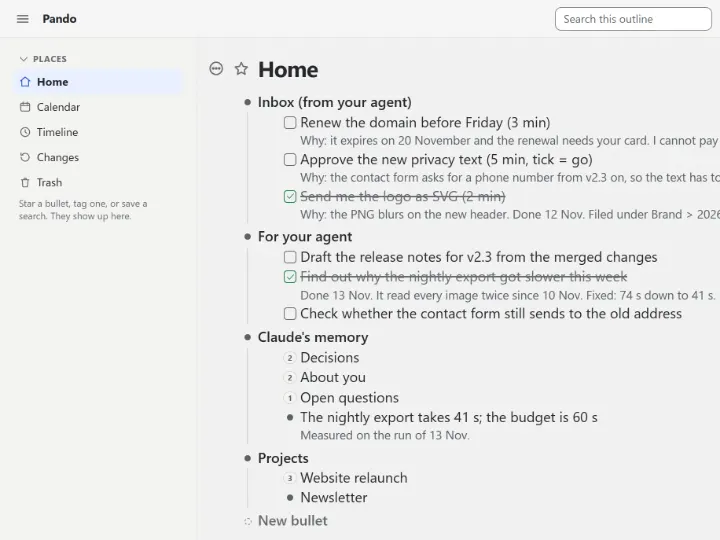
The inbox your agent writes for you
When Claude reaches a step only you can take, it should not ask in a chat that scrolls away. It should write a checkbox task into a list you both read, and carry on with the rest.
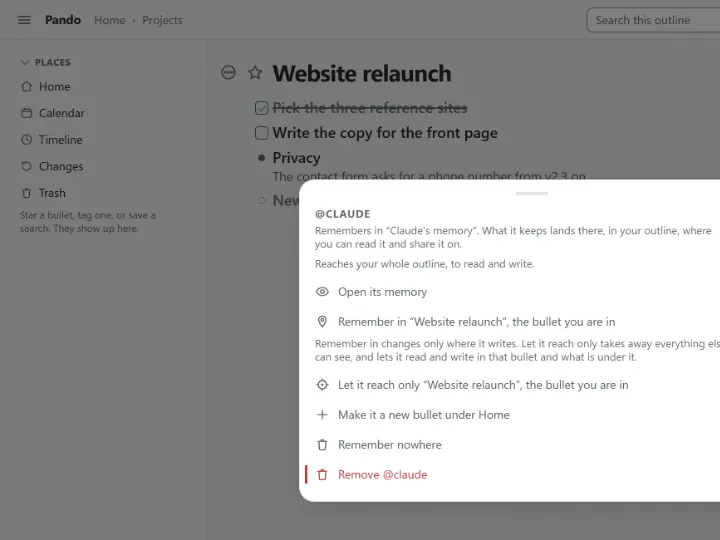
Share one branch with your agent, not your whole outline
Your notes hold the project you want help with and a lot you never meant to show an agent. A sentence in the prompt asks Claude to stay out; a grant on the server makes it unable to look.
Two agents, one tree: Claude in the app and Claude Code at the desk
Two Claude Code sessions in one repository can share a CLAUDE.md. Once one of the agents is the Claude app or ChatGPT, the decisions both need have to live somewhere both can read, and you should be able to read it too.
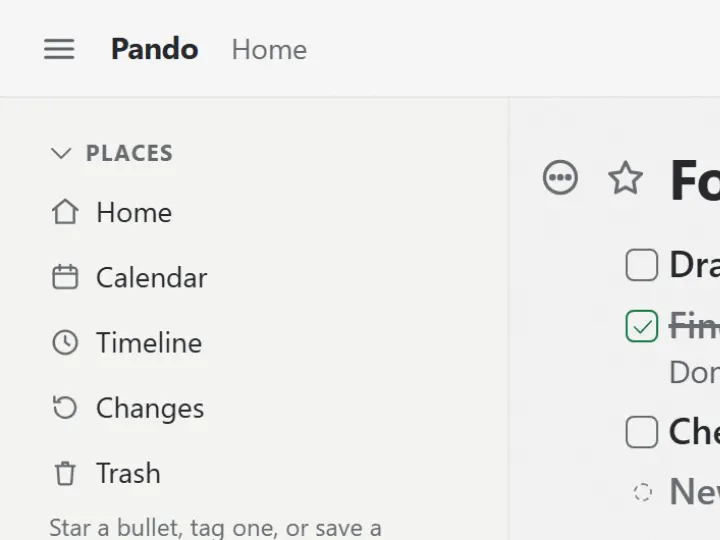
The list your agent reads first, and why I stopped writing it myself
A list of work that your agent reads before anything else keeps requests from dying with the session. I kept one for two weeks, then let the agent write it from what I say in the chat. What each version is good for.
Steering Claude Code from your phone without reading the transcript
Remote Control puts a Claude Code session from your own computer on your phone. What it does not change is that a session is a long transcript. How I steer the agents that build Pando from the phone with two short lists and checks that a program runs, not the agent.
Give your agent a table, not a paragraph
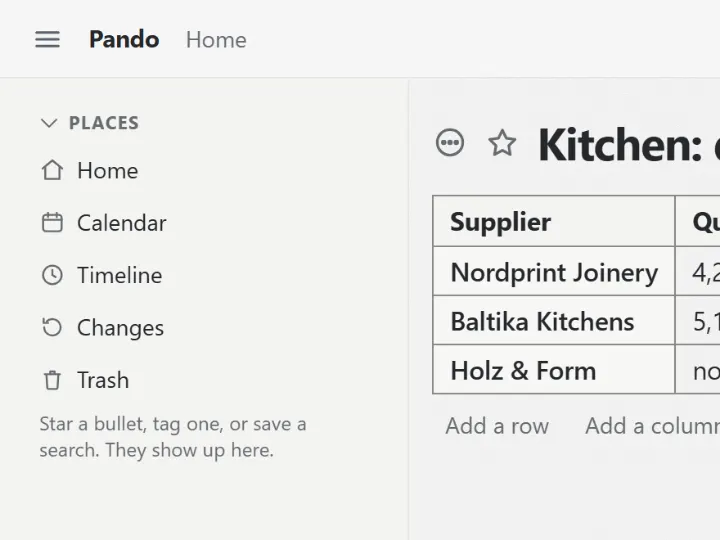
When an agent keeps facts that repeat, such as quotes, statuses or dates, a table in your outline makes each update one cell and shows you the gaps at a glance on your phone, and it turns back into a list with one change.
Getting Things Done in one outline instead of five apps
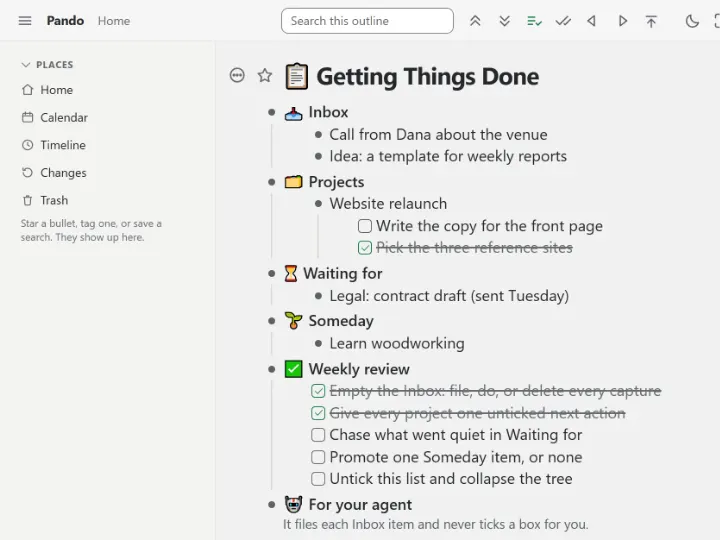
GTD usually fails between the apps: the capture is in one place, the projects in another, and the weekly review means opening all of them. In one tree the five lists sit on one screen, and Claude drafts the filing for you to check.
The weekly review that survives past March
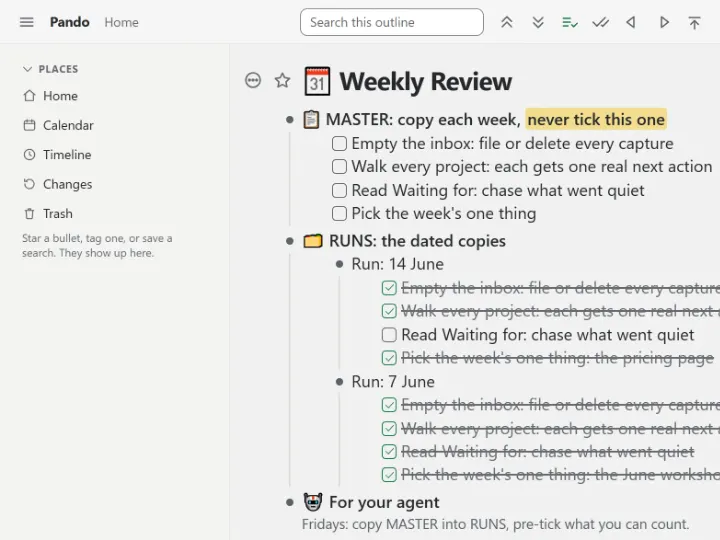
A weekly review slides when it costs a walk through five lists and leaves nothing behind. A master checklist with dated runs in one tree makes it shorter and gives it a record, and Claude can prepare each run.
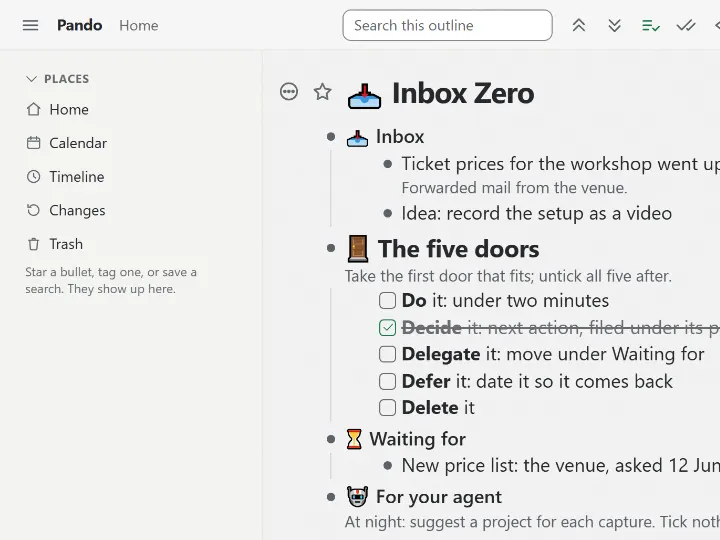
Inbox zero: Merlin Mann's five exits for any inbox
Merlin Mann gave every item in an inbox five ways to leave. They work on any inbox, a mail folder, a notes app or the list Claude writes into, as long as the places they lead to are close by.
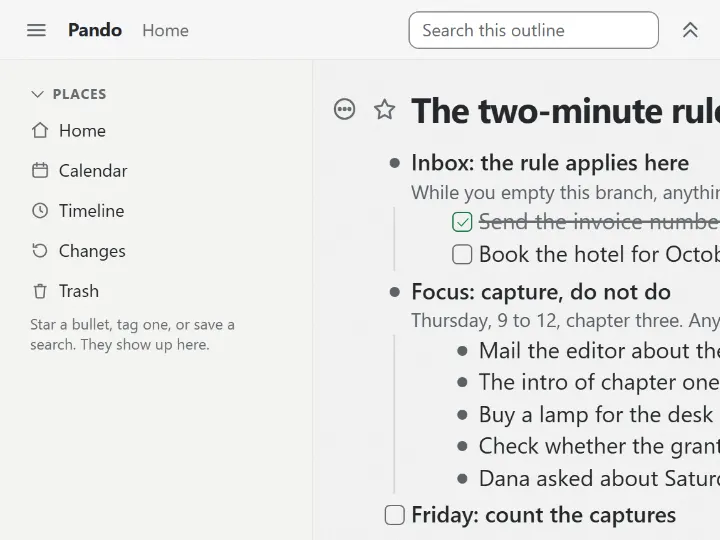
Where the two-minute rule stops working
Do it now if it takes less than two minutes. David Allen wrote that for the moment you empty an inbox; applied to a morning of focused work, it can eat the morning.
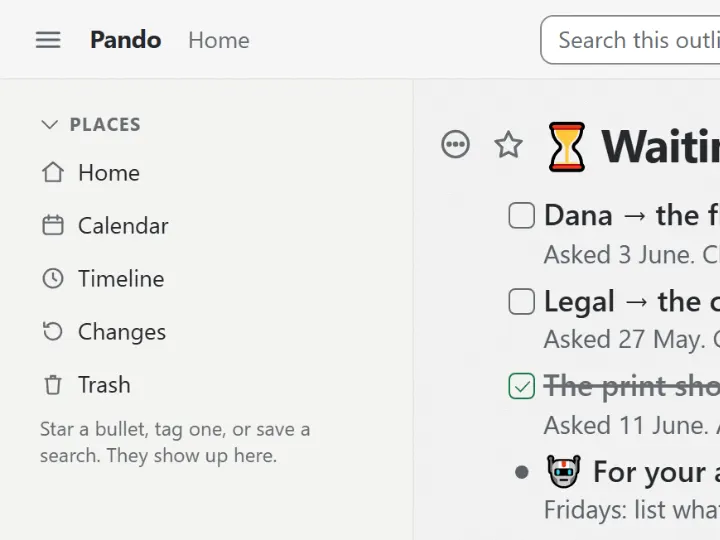
The Waiting For list: three fields and a Friday check
Things other people owe you are in nobody's task list, so you notice them when the consequence arrives. A Waiting For list with who, what and the dates you asked is a short list to keep, and Claude can tell you what has gone silent.
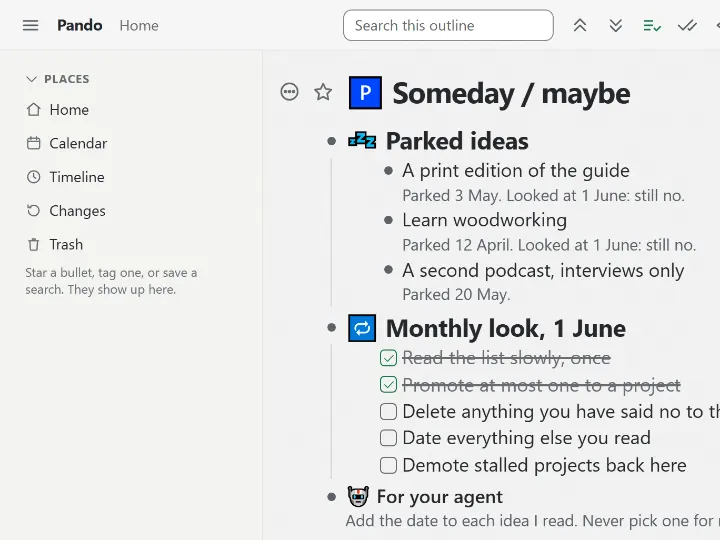
Someday/maybe: park ideas with two dates
An idea you are not doing this year still sits on your project list and makes the list harder to trust. Parking it on a someday list with two dates is a smaller decision than deleting it, and one you can make today.
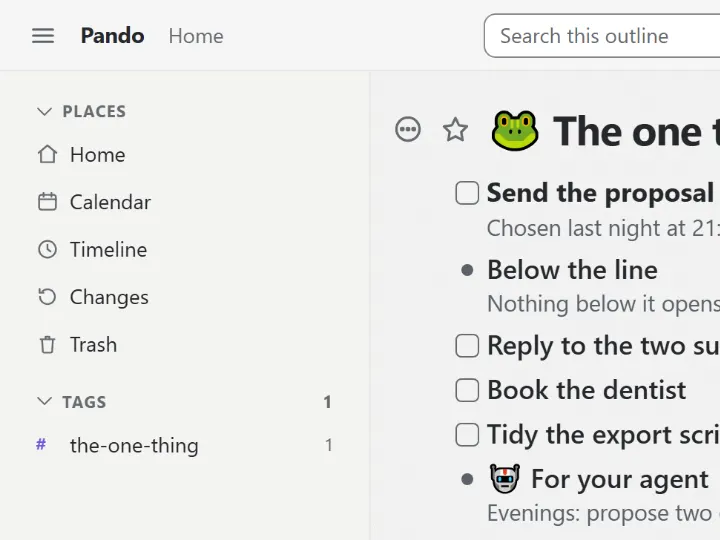
Eat the frog, but choose it the night before
Doing the hardest task first is good advice that tends to fail at 08:45, because that is when you have to pick it. Brian Tracy's own book also says to plan the day the evening before, and that half moves the choice out of the morning.
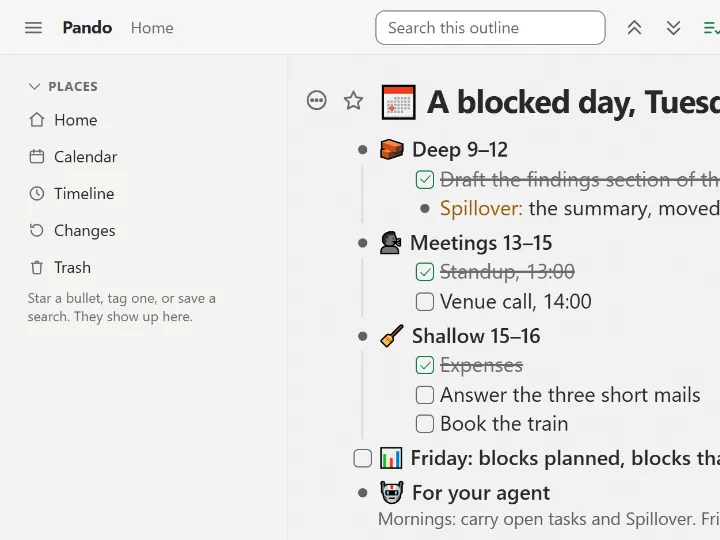
Time-blocking for a to-do list that never fits the day
A to-do list holds eleven tasks for a day with four free hours and gives no warning. Giving each task a block of the day shows in the morning what does not fit, while there is still time to choose.
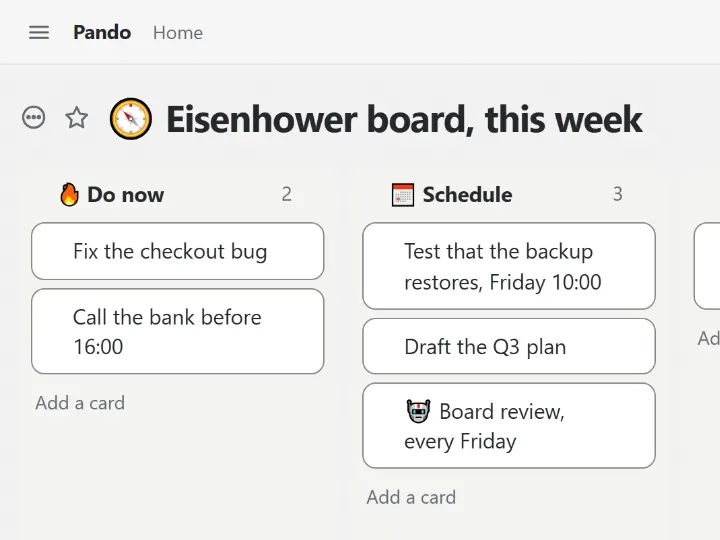
The Eisenhower quadrant that stays empty unless you fill it
Urgent work announces itself, so three quadrants of the Eisenhower matrix fill up on their own. The fourth, important and not urgent, stays empty unless you put things there and give them a day.
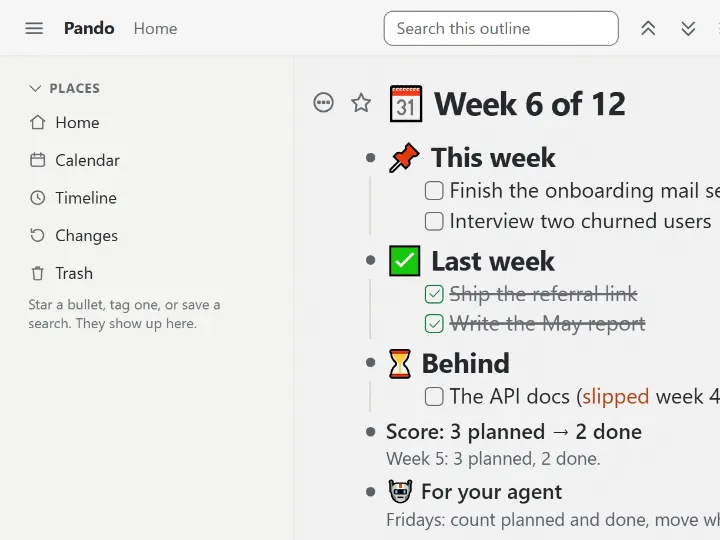
The twelve-week year for one person
A goal for the whole year leaves room to postpone until autumn. Twelve weeks with the week number in the title leaves little room, and a Friday score tells you whether the plan was too big.
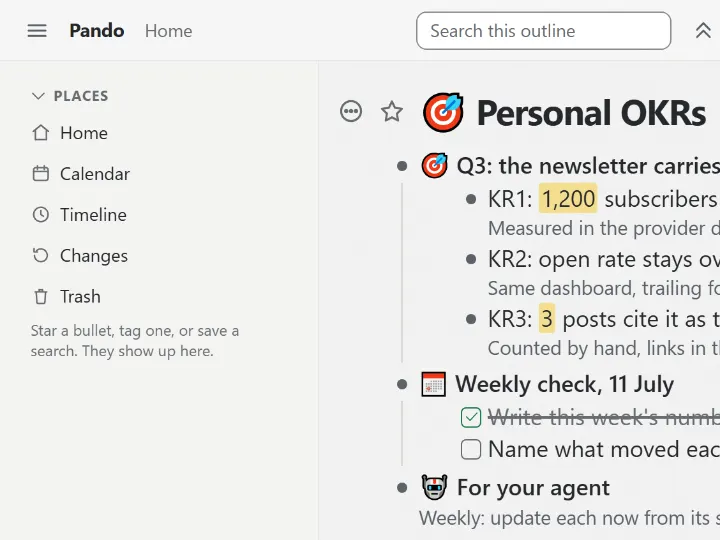
OKRs for one person: key results you can count
Personal OKRs usually fail at the key results, which turn out to be smaller wishes. The repair is one rule, a number with a source, and a short check each week.
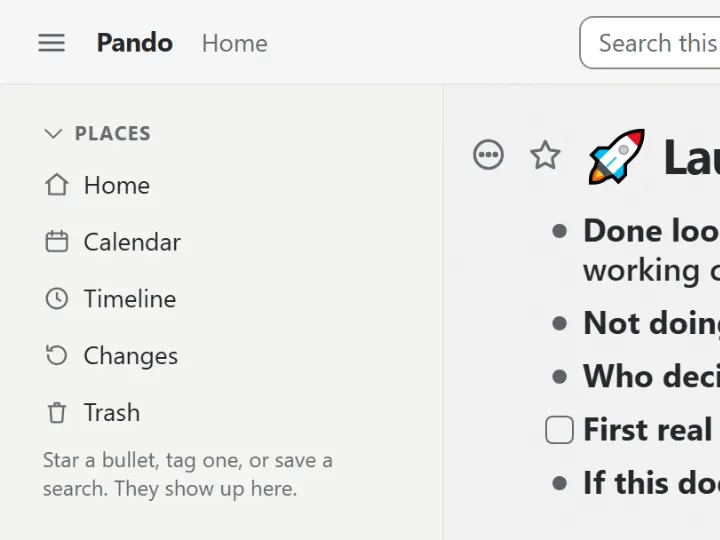
The project brief that fits in five bullets
When a project has stalled for months, check whether anyone wrote down where it ends. Five lines under the project, written in a few minutes, say what done means, what is out, who decides, the first step and the cost of dropping it.
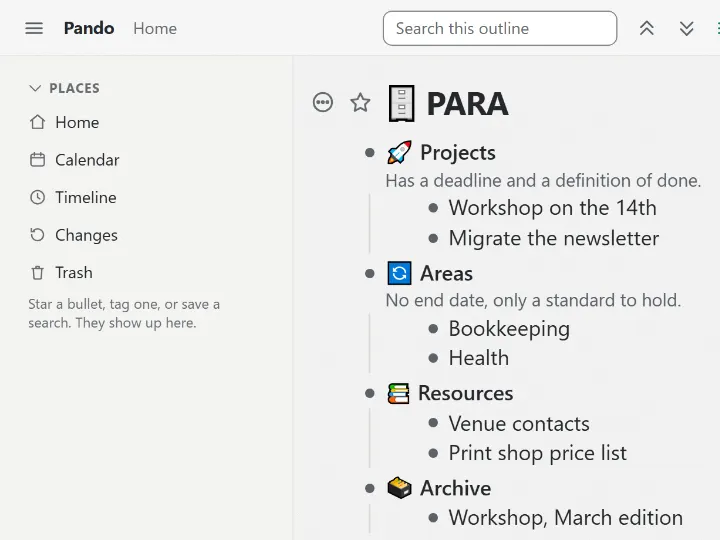
Where does this note go? PARA files it by when you will act
A note about a supplier fits under four topics, so it ends up in a different one each time. PARA asks how soon you will act on the note instead, which is easier to answer.
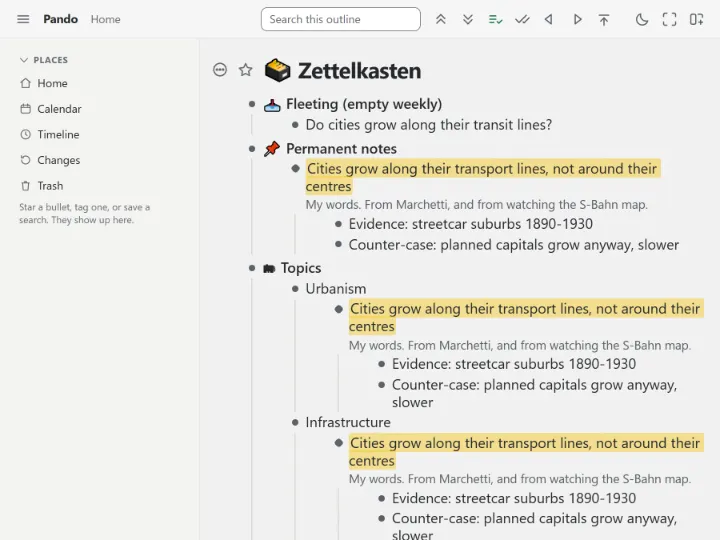
Zettelkasten without the graveyard
Luhmann's box connected its notes in three ways, and most digital copies keep only the box. An outline can give each note a place behind the one it continues, links to others and a spot under every topic it belongs to.
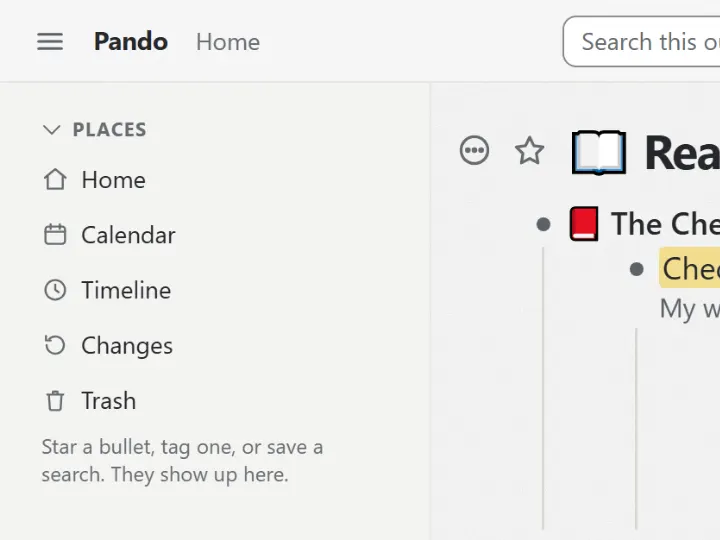
Reading notes nobody reads: put your own sentence on top
Exported highlights pile up unopened, because each one is somebody else's sentence. Write the idea in your words as the parent, hang the quote under it, and add where it applies to you.
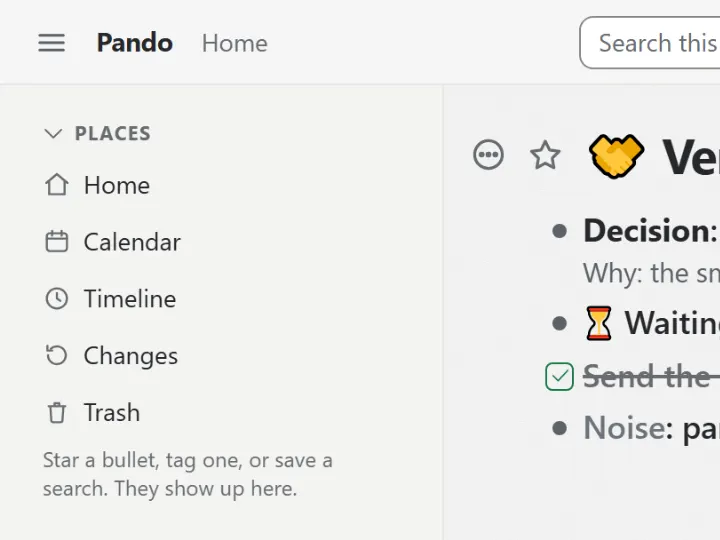
Take the decisions out of your meeting notes
A meeting note is a note about a Wednesday, and nobody reads those again. Write four kinds of line, then move three of them to the places where the work happens.
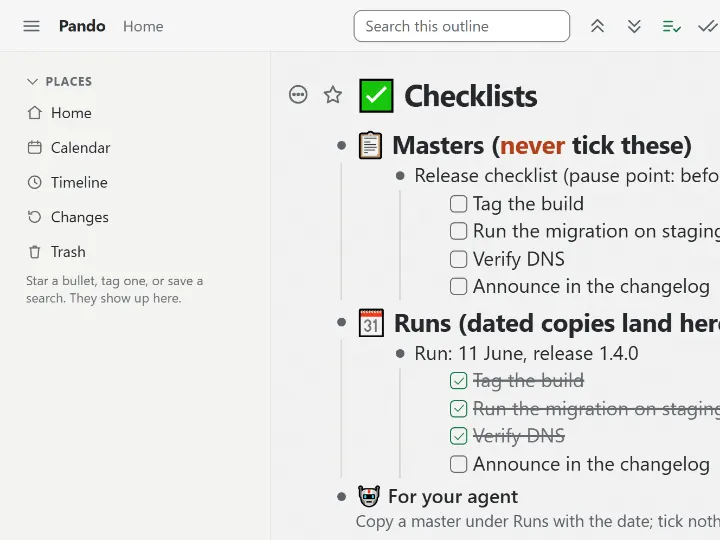
The Checklist Manifesto in an outline
Experienced people skip steps they know well, under pressure. Gawande's checklist rules, with clean masters you never tick and dated runs you do, as a tree you can copy.
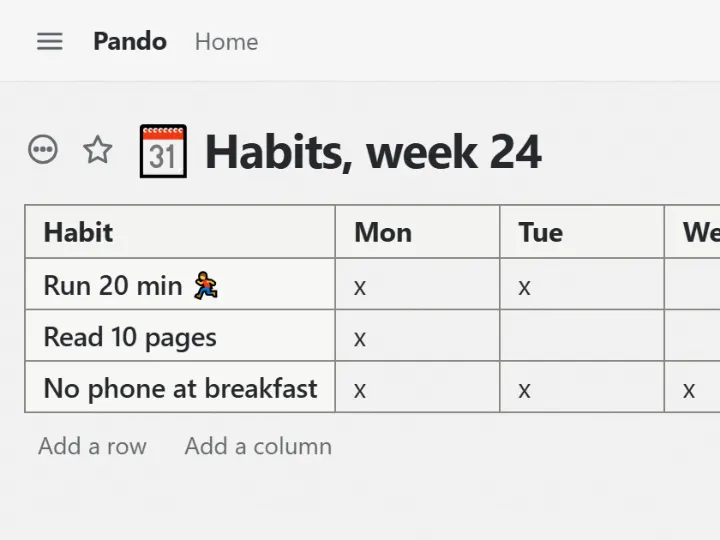
The habit table that shows the days you skipped
A streak counter shows one number and resets it on the first missed day. A table with a column per day keeps the blanks, so you can see which days you miss and change the habit to fit them.
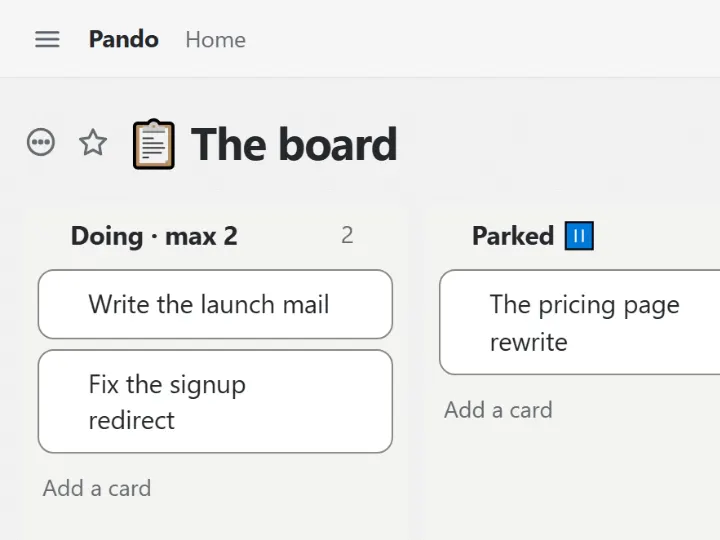
Personal Kanban: a board with a work-in-progress limit
Personal Kanban has two rules, a board and a limit on how many things are in progress at once. The board is the easy part; the method relies on the limit, and a lane for parked work keeps the limit workable.
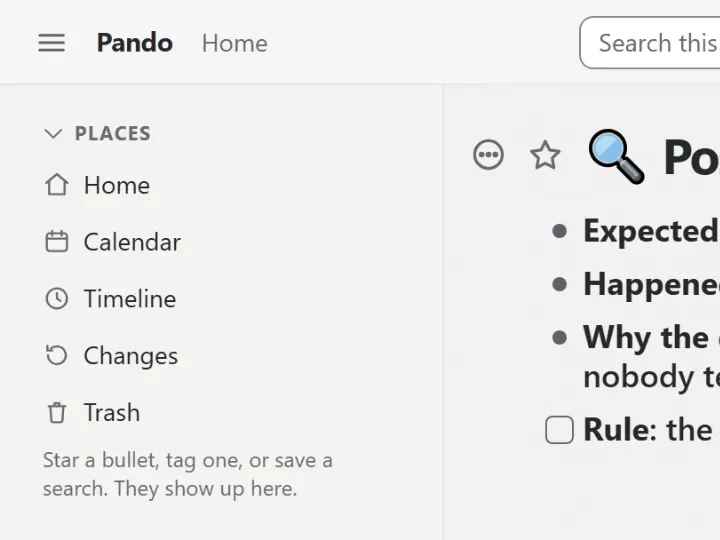
The post-mortem you will actually write
Four lines, written the week a project ends: what you expected, what happened, why they differ, and one rule for next time as a checkbox. The rule is the line you act on.