The project brief that fits in five bullets
by Andreas Tissen · · updated
Look at your project list and pick one that has been open for a while. Now answer three questions about it. What does done look like? Who decides? And what happens if it does not happen at all?
If any answer takes more than a sentence, that project is not stalled by execution. It was never defined. No amount of next actions will fix a project whose finish line nobody drew.
Five bullets, four minutes
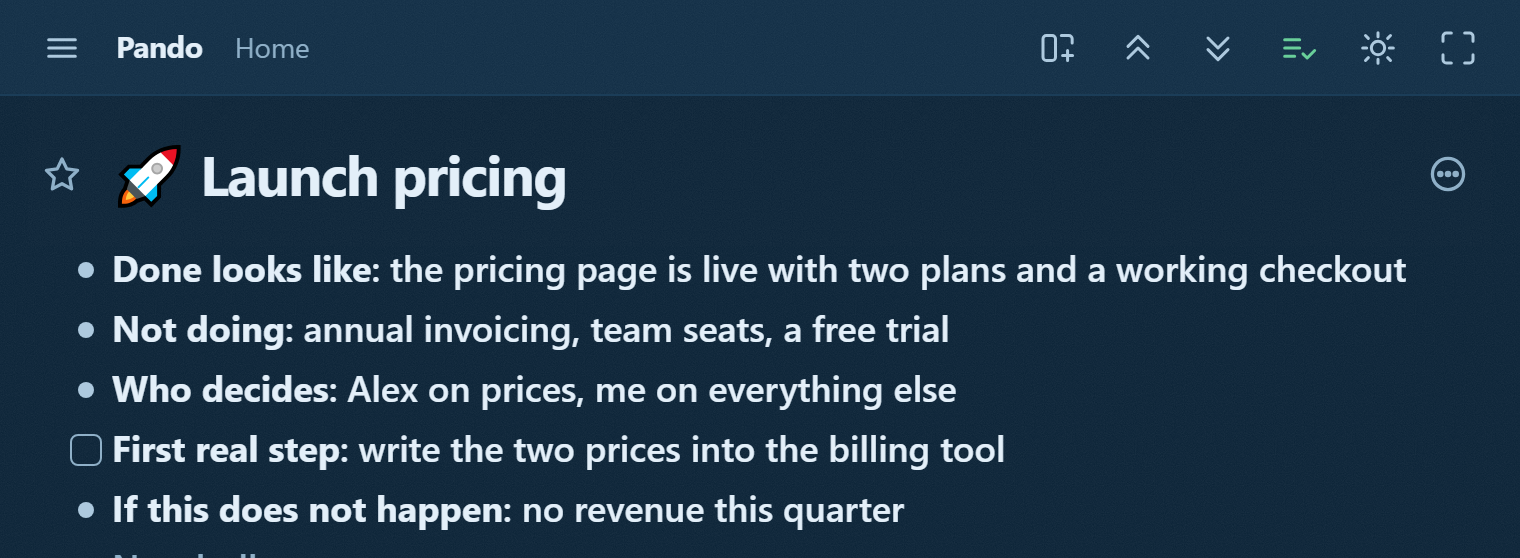
Write these under the project bullet, before the first task:
- Done looks like. One sentence, in the past tense, that somebody else could verify. "The pricing page is live with two plans and a working checkout" passes. "Pricing sorted" does not.
- Not doing. The two or three things people will assume are included. Nobody writes this line. It is the most valuable one.
- Who decides. For a personal project this is usually you, and writing it down still helps: you see which decisions you are waiting on somebody else for, and those are the decisions a project quietly stalls on.
- The first real step. Something that changes something. "Plan the project" does not qualify.
- If this does not happen. One line. Half of what is on your list turns out to have a comfortable answer here, and those projects belong in Someday rather than on the active list.
The line that saves the most time
"Not doing" is the one to force. Scope does not creep during a project because discipline is weak. It creeps because the boundary was never written, so every new idea sounds like it was always part of the plan.
Once the boundary is written, an addition becomes a decision instead of an assumption. "That is not in this, do we change it?" Most of the time the honest answer is no. You would never have said that out loud without the line.
Where it lives
Under the project, above the tasks, and it stays there while the work happens. A brief in a separate document is a brief nobody rereads, and the whole point of the "not doing" line is that you read it again in week three, when somebody suggests the obvious extra thing.
Bullets can be edited when reality changes, with the change visible. A brief that was quietly rewritten is worth nothing. One that shows the scope moved on the fourteenth is a record you can learn from at the post-mortem.
The agent's use for it
This is the single most useful thing to hand an agent alongside a task. "Done looks like" plus "not doing" beats most prompts as a specification, and an agent that reads them stops proposing the helpful extra work you already decided against.
Four minutes, now
Open the template, press "Show in my Pando", then take the oldest project on your list and write the five bullets. Two things usually happen. One project gets noticeably easier, and one turns out to belong in Someday. Both are worth four minutes.