Give your agent a memory it can keep
by Andreas Tissen · · updated
Your agent remembers you now, one product at a time. Claude keeps what it learns about you as topics in its settings, Claude Code writes a MEMORY.md on the laptop it runs on, and nothing in Anthropic's own docs connects the two, so Claude Code at your desk has no idea what you told Claude on your phone this morning. This is normal. It is also absurd.
You will not fix this with a better memory inside any one of them. Humans solved the problem a long time ago. We write things down, in one place everybody can read.
A branch of its own, next to yours
In Pando the agent gets a real branch of a real outline. What it writes on Tuesday it reads on Friday. So can you: there is no hidden vector store, the memory is bullets on your screen, sitting in the same tree as your own notes.
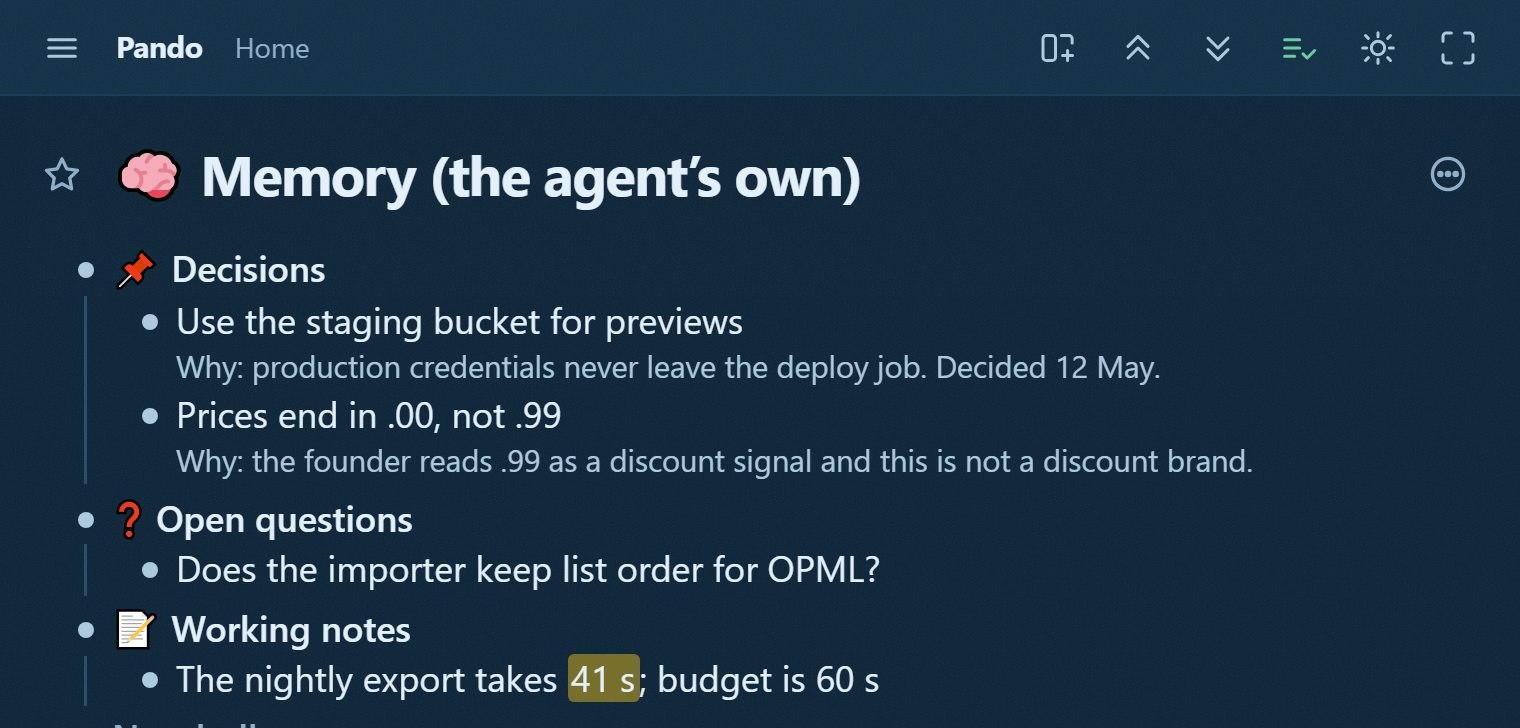
The picture shows the shape I settled on: decisions, with their reasons. Transcripts are the wrong thing to keep, because re-reading one costs more than you learn from it. A decision is three lines, the note under it holds the reason, and the agent in a future session gets the rule together with the reasoning that produced it.
The two-minute setup
Pando supports MCP, the protocol Claude, ChatGPT and most agent frameworks use for tools. Setup is three moves.
- In your agent's connector settings, add
https://pando.ink/mcpas an MCP server. - Sign in on the consent screen and read what it lists: whether the agent may write or only read, and a box that gives it a bullet under Home to remember in. It reads your whole outline either way, and it can write in its memory bullet even when you choose read only.
- Ask: "check your Pando memory and tell me what you know."
That last sentence is the whole habit. The first time, the agent finds an empty branch and says so. Every session after that, it starts from its own notes instead of from zero.
Protection is explicit
A connector you approve starts with your whole outline. What it must not change, you protect: a protected bullet refuses every agent, and everything under it does too. For a narrower reach, open the branch it may work in and point it there: open Agents and API keys in Settings, tap its row under Your agents, and press "Let it reach only", the button that names the bullet you are in. It reaches that branch and nothing else, and it may write there even if you approved it read only. An agent you create under Agents and API keys with both of its boxes unticked, "Let it read and write this outline" and "Give it a bullet of its own to remember in", reaches nothing until you make the same press. Its key is for clients that send a Bearer header, such as Claude Code or Cursor.
Most agent-memory products give the agent the whole vault and a promise to behave. A Pando connector starts with the whole outline too. The difference is what holds without the promise: you can approve it read only or hold it to one branch, a protected bullet refuses it, and one press revokes it.
What changes, measured on my own work
This product is built by an agent using its own memory branch, so the numbers are ours. Before: the first ten minutes of every session went on re-explaining deploy rules, test caveats and naming decisions. After: the agent reads its Decisions branch, asks one delta question, and starts. The ten minutes happen once. Not every day.
An agent with a memory also fails better. When it is wrong, you correct the note rather than the agent. Fix the line in its branch, and every session after that starts from the corrected note.
Try the honest version
Open pando.ink, connect your agent to /mcp, and ask it what it knows. Today the honest answer is nothing. The interesting one comes in a month.