Pando vs Roam Research, if the price is why you are leaving
by Andreas Tissen ·
Your Roam renewal is coming up, you looked at the number, and you typed "roam alternative" into a search box. Somebody who left Roam put it in eight words in r/RoamResearch on 13 March 2026: "I would have stayed if it were cheaper."
I will put the deal-breaker first, before any talk of money. Pando has no block references, no query blocks and no graph. Both are outliners, but Pando is one tree: bullets in bullets, and any bullet can become the page. A bullet can link to another, and its menu says what links to it, but that is one search, not a Linked References section under every page. If you open Linked References ten times a day, Pando will feel like a step back, because it is one.
TL;DR. Roam is the better tool for anybody who thinks in block references and queries, and for Claude and ChatGPT its agent door is the finer-grained one. Pando is the cheaper place for somebody who only outlines: free for 1,000 bullets with no card, where Roam asks $165 a year and has no free plan. Past 1,000 bullets Pando has no published price yet, and a Roam graph that is years deep is almost certainly past that line.
At a glance
| Roam | Pando | |
|---|---|---|
| Price | $165 a year ($13.75 a month) or $15 month to month, for unlimited graphs and collaborators with no block limit listed; Believer $500 for five years ($100 a year) | free for 1,000 bullets, every feature, no card; Pro is not for sale yet |
| Free way in | a 31-day trial, with a card | the free plan |
| Hosted MCP server | yes: 20 tools, OAuth, you choose the graphs and a level for each | yes: twelve tools, OAuth, the whole outline, read and write or read only, or one bullet you pick afterwards |
| Keep notes from the agent | a graph you do not connect, an encrypted graph, or #.rm-hide (not the raw Datalog query) | a lock stops changes, not reading; an agent held to one bullet reaches nothing else |
| Block references, queries | yes, in two query languages | no; a saved search with operators is the nearest thing |
| One block live in two places | {{embed}} | a mirror |
| Backlinks | Linked References under every page, with filters | a bullet's menu lists what links to it |
| Daily page | Daily Notes, where Roam opens | a day under Calendar, one key away |
| Graph History, Graph Overview, Roam Depot, encrypted graphs, more than one graph, semantic search, comments | yes | no |
| Offline | hosted graphs work offline and sync later | what you write is kept and sent when the network returns |
| Export | Markdown, JSON, EDN, MessagePack, also after you stop paying | Markdown, OPML, a spreadsheet, formatted text, a whole-account backup |
| Phone | native iOS and Android apps | the web app |
What Roam costs
Read off Roam's landing page on 23 September 2026:
- Pro: $15 a month, or $165 a year, which the page also shows as $13.75 a month.
- Believer: $500 for five years, which the page shows as $100 a year.
- A 31-day trial, only if you have never had a plan, and "You'll be charged after 31 days". Roam's FAQ adds that the trial takes a card.
There is no free plan. The pricing section holds exactly two cards, and the app says "To create new hosted graphs you must choose a plan".
If the price is your only complaint, there are ways to pay less without leaving. Month to month comes to $180 a year, so the yearly plan alone saves $15. Believer comes to $100 a year against $165, although it asks for $500 on the day and five years. Roam also had a Scholar discount, with nearly 18,000 Scholars in 2021. I could not find it on the pricing page or in the app's code today, so ask Roam before you count on it.
One thing in Roam's favour belongs right here. When you stop paying, your notes stay where they are: the graph turns read-only, and the app tells you "You are still able to read and export your notes". So you do not have to export in a hurry before the renewal date. Roam's help says cancelling has "0 effect on your notes". Take a whole-graph export in EDN or JSON anyway, which Roam allows after the plan ends, because a copy on your own disk needs nobody's promise.
What Pando costs past 1,000 bullets
Pando is free for 1,000 bullets. Every feature is in the free plan, agents included, and no card is asked for. Pro, which lifts the limit, is not for sale yet, so I cannot put its price next to your $165.
Three blocks a day for a year is already past 1,000, so here is what happens at the line. A free account cannot make new bullets past it, and nothing is deleted. While Pro is not for sale, reaching the line gives you three months of Pro for free, and when those end, one more month at a time. When Pro goes on sale, the months already given run to their end, and after that the way past 1,000 is to pay a price that is not published today.
So if you bring a graph of thousands of blocks, you live on free months from the first day and on a price you cannot see yet after them. Bring only the pages you work in, and the line may never come up.
For Claude and ChatGPT, Roam's agent door is finer
If a comparison told you Roam has no way in for an AI agent, it is out of date. Checked on 23 September 2026:
- Roam runs an official MCP server on its own servers, listed in Claude's connector directory as "Anthropic verified". The listing says "Added June 2026", and Roam announced "Roam MCP is out!" on 28 July. Its help page says "your computer doesn't need to be on".
- You sign in over OAuth, choose which graphs to connect, and give each graph its own access level, from read-only to full.
- Roam's MCP changelog also names a read-edit-own tier, enforced on Roam's server.
- It has 20 tools, including queries, comments and an append to the daily note.
- An agent's edits carry an "(AI)" author, so you can find everything it wrote.
- A page called
[[roam/agent guidelines]]holds your instructions, and connected AI tools read it before they start. - Blocks tagged
#.rm-hideor#.rm-privateare left out of what its read tools return, the raw Datalog query excepted. - No Roam page says which plan it needs, but Roam has no free plan, so in practice it comes with one.
There is also a local server for the desktop app, with 33 tools, labelled Alpha Software. Roam recommends it anyway if you work on the desktop: "The local MCP offers more features and is recommended if working from desktop." It works with encrypted and local graphs, and it starts the desktop app by itself when a tool calls.
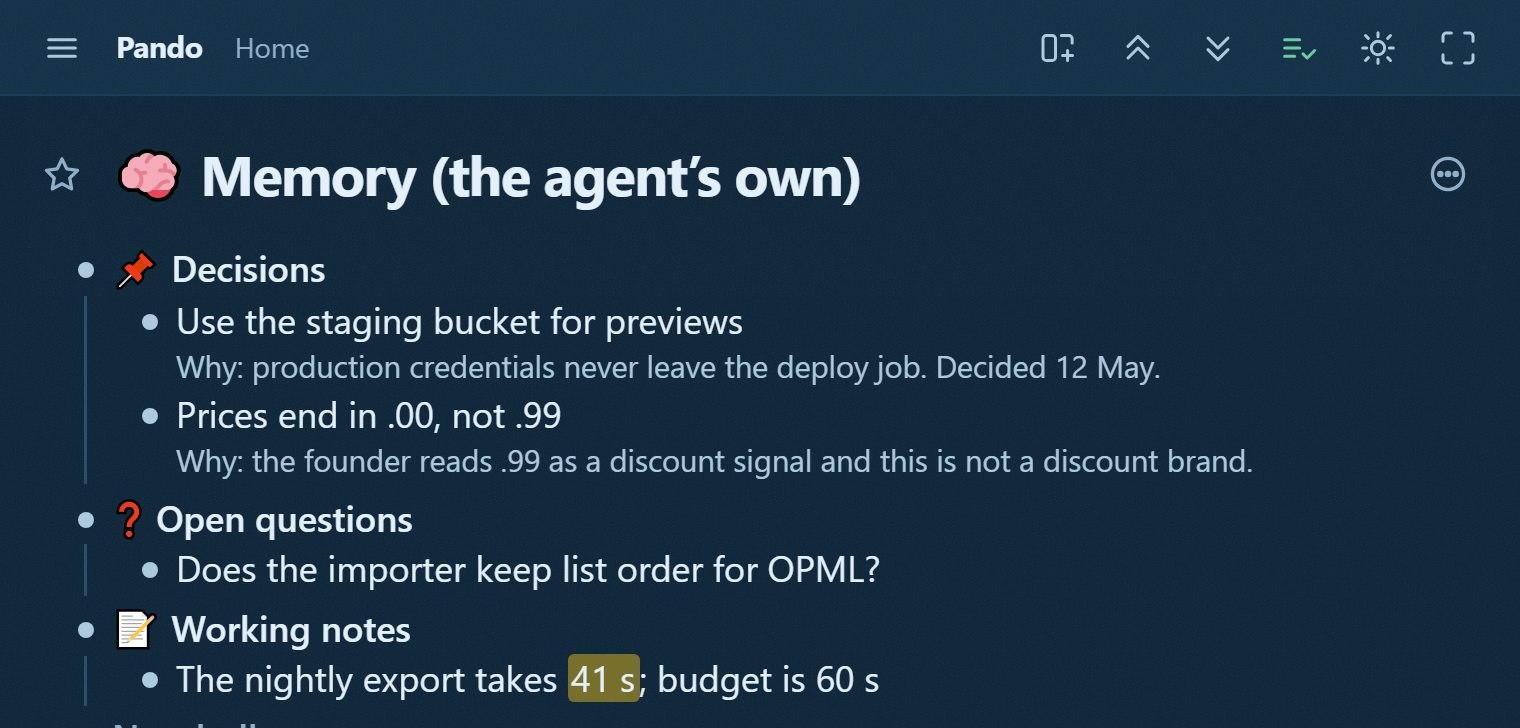
Pando's server is hosted too, with OAuth sign-in and twelve tools. Claude, ChatGPT or Claude Code connects, and the connector you approve reads your whole outline, read and write or read only. There is no choice of branch at that door; one press in the app holds it to one branch afterwards. You pick where it remembers, or that it remembers nowhere, and what it writes there on Tuesday is still there on Friday. Give your agent a memory shows the shape I settled on for that bullet.
So for Claude and ChatGPT, Roam's door is the finer-grained one. You choose which graphs the agent sees and what it may do in each, where Pando's connector sees the whole outline until you hold it to one branch. Notes that are none of the agent's business can live in a Roam graph you never connect, or in an encrypted graph, which the hosted server can only append to. Roam's #.rm-hide hides single blocks as well, although Roam's own help calls it "a convenience filter, not a security guarantee", because the raw query tool reads the database directly.
Pando's fences sit on bullets. A protected bullet refuses every change from every agent, and everything under it does too, but a lock stops changes and does not hide anything from reading. An agent held to one bullet reaches that bullet and everything under it, to read and write, and nothing else. Open the bullet, open Agents and API keys in Settings, tap the agent's row under Your agents, and press "Let it reach only", the button that names the bullet you are in. That works for a Claude or ChatGPT connector, and for an agent you create there whose key goes in a Bearer header, from clients such as Claude Code, Codex or Cursor.
Both sides remember. Pando's server tells the agent to recall before it assumes, Roam's agent reads the guidelines page first, and the leading community server for Roam has remember and recall tools of its own. What is left on Pando's side is the price: its door is on the free plan, and Roam's sits in an app that has none.
Moving out of Roam
Roam exports Markdown for one page or for the whole graph, and Pando imports Markdown. The shape comes across, and so do the words of each block. Their formatting is read the way Markdown reads it, where __text__ is bold, so bring one page first and look at it.
Pando's importer does not read Roam's own syntax, so here is what those words become. A [[Page]] arrives as those characters, not as a link. Where the file still holds a ((block reference)), it arrives as the id in its brackets, not as the words it pointed to, and an {{embed}} arrives as its characters too. Where a block links a picture or PDF you uploaded to Roam, only the address comes across, and the file stays on Roam's storage at Google Firebase. Roam's own to-do marker, where the file carries it, arrives as plain text, because Pando makes a to-do only of Markdown's [ ] and [x], so replace the markers in the file first if you want boxes. A one-word #tag does become a Pando tag. Moving in has what each file format carries and what it drops.
Roam's whole-graph export is one zip, and Pando does not unzip anything, so you unpack it yourself and bring pages in one press at a time. If you write in Daily Notes every day, that alone is 365 pages a year, so a few years of Roam is well over a thousand presses. Bring the pages you work in now, which also keeps you further from the free line. Leave the archive in Roam, where it stays readable after you stop paying, and keep the EDN or JSON export of the whole graph on your own disk as well. Roam can read either back in if you ever return.
What stays behind is everything that depends on the graph rather than the tree: block references, backlinks and queries. Every imported bullet gets a new address, too.
Before anything is written, the importer shows you the file, the format, the number of bullets and where they will land. If it lands wrong, undo takes it back out.
If you were never in Roam and came here from Workflowy or Dynalist, you hold an OPML file, and Pando vs Workflowy is the comparison written for you.
Where Roam wins
Block references. Every block has an id, and a reference shows that block's live words inside your own sentence: edit the original, and every reference changes. A Roam user put it this way in July 2026: "The ability to edit a note and have it show up in 29 places is unmatched". Pando's nearest thing is a link to a bullet, whose label is the words it had when you pasted it.
Linked References and queries. Linked References collect every link to a page, with filters. Queries come in two languages: {{query:}} blocks in Roam's own syntax, and Datalog in :q blocks, the API and the agent's tools. Pando has tags, mirrors, dates and a search with operators such as OR, is: and has:, and a saved search stays live in the sidebar. A bullet's menu lists what links to it. There is no query block inside a page, and no Datalog.
Daily Notes. Roam opens on today's page. Pando has a day too, one key away (Alt+T, or Ctrl+T on a Mac), and a bullet that carries a date shows on its day. What it lacks is the other half, where the pages a daily note names collect it underneath.
Graph History. You can open the graph as it was at any past moment. Graph Overview belongs here too, and Pando has nothing like it, since it has no graph.
More than one graph. Pro includes unlimited graphs, so work and private notes can live apart. A Pando account is one outline.
Roam Depot, the extension library the Roam team reviews, with 208 manifests in it, and roam/js for scripts of your own.
Encrypted graphs, which the hosted MCP server cannot read and can only append to.
Semantic search, which finds blocks by meaning rather than by their words. Its switch sits under Experimental in the graph settings, per Roam's July 2026 changelog. The default option needs no setup when the graph's admin pays, and an agent reaches it only through the local server.
Comments, which an agent can read and add without touching your text.
Native apps on Mac, Windows and Linux, the iPhone, the iPad and Android, plus a PDF annotator and Roam Reader for reading on the web. Pando is a web app on your phone.
An API family, with Backend, Append and Local APIs and SDKs in five languages.
Where the two overlap
One block in two places. Roam's {{embed}} shows a block in a second place, and an edit inside the embed changes it everywhere. Pando's mirror does the same with a whole bullet. Type (( in Pando, as you would in Roam, and you get a mirror of the bullet you pick, though not a reference inside your sentence.
Offline. Roam's hosted graphs work offline and sync when you are back, and its phone app saves Quick Capture offline. Pando keeps what you write offline and sends it when the network returns.
Sharing. Roam's Pro includes unlimited collaborators. You invite people by email to read or edit the whole graph, and a single page goes out only by public link, which Roam warns "loads the rest of your graph's data in every visitor's browser". Pando shares a branch, with a person or by link, to read or to edit. But if your people already work in your Roam graph, leaving means they move too.
If Roam works for you, keep it
Keep paying if one of these is you:
- You use block references, Linked References or queries every day. $165 a year buys things Pando does not have, or has only as a search, and Roam does them well.
- Your day starts on the Daily Notes page and runs through the pages it links.
- Other people work in your graph with you.
- You capture on the phone and want a native app.
- You rely on an encrypted graph, Graph History, Roam Depot or roam/js, or you keep more than one graph.
- Your graph runs to thousands of blocks and you mean to keep adding to it in one place. Past 1,000 bullets Pando has no price you can read today.
If price is your only complaint, pay less before you leave: the yearly plan is $165 against $180 month to month, and Believer is $100 a year for $500 on the day. If you are a Believer already, price is no reason for you to leave.
Move if the graph is the part you never open: you outline, you tick things off, and the query box has been empty since the week you signed up. And you do not have to move for your agent's sake, because for Claude and ChatGPT Roam's door is the finer one.
Open Pando, bring in the one page you open most, and see whether an outline without the graph is enough for you.